

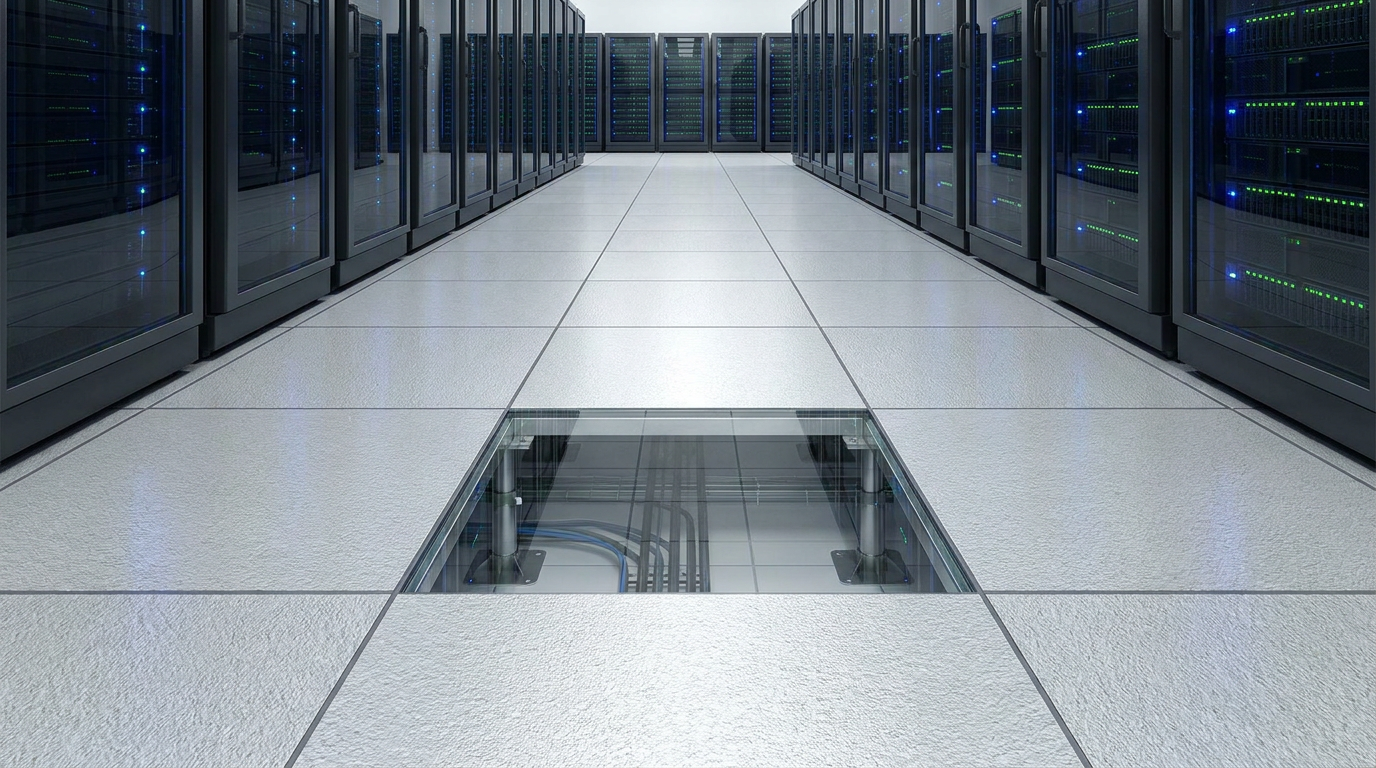
The data center industry is in the middle of its most demanding transformation in two decades. AI training clusters are pushing rack densities from a comfortable 5 to 10 kW per cabinet to 40, 80, even 130 kW. Liquid cooling has moved from an experimental option to a mainstream deployment strategy. Hyperscale operators are chasing PUE values below 1.2 while enterprises retrofit legacy rooms to host GPU workloads they never planned for. In this environment, the floor beneath the servers is no longer a passive surface. It is a load-bearing, airflow-managing, static-controlling piece of infrastructure that quietly determines if the room performs at spec or fails at scale.
ESD flooring, once treated as a commodity line item, has become one of the most consequential decisions in server room design. A wrong choice in 2026 means premature replacement within five years, failed fire inspections under current data center codes, or worse, silent chip damage across an entire GPU cluster from uncontrolled electrostatic events. This guide examines the leading ESD flooring options for data centers and server rooms in 2026, grounded in the technical realities operators face today.
Why ESD Flooring Matters More in 2026 Than Ever Before
Static control in a server room used to be a checkbox item. Today, it sits at the intersection of three converging pressures that turn flooring choice into a strategic decision.
✅The Rising Cost of a Single Static Event
Modern semiconductors are more static-sensitive than any generation before them. Where a 1990s memory chip could tolerate a 2,000-volt discharge, current GPUs and high-bandwidth memory modules can degrade at under 100 volts, often below the threshold a human can even perceive. A technician walking across an ordinary floor without wearing heel straps can accumulate 5,000 to 15,000 volts of body voltage in seconds. When that charge finds its way to a rack, it may not cause immediate failure. Instead, it produces latent damage: intermittent errors, shortened component life, and diagnostic nightmares that surface months later during peak workloads.
For an AI training rack worth several hundred thousand dollars, the economics of prevention are obvious. Yet many rooms still rely on aging vinyl or generic laminate floors whose ESD properties degraded years ago.
✅Resistance Numbers Alone Don’t Tell the Truth
One of the most persistent misconceptions in the industry is that low surface resistance equals static safety. Field measurements consistently prove otherwise. When two conductive floors, one vinyl and one rubber, are tested side by side, both may register resistance in the 10⁵ Ω range and appear equivalent on a compliance report. But when a person walks across each without heel straps, the vinyl floor can generate body voltages more than ten times higher than the rubber. Resistance measures the path to ground; body voltage measures what actually gets generated on a walking human. Since technicians in server rooms almost never wear ESD footwear, the floor material’s tribocharging behavior matters as much as its resistance rating.
This is why modern selection increasingly favors materials with through-body conductive structures, such as calcium sulfate cores with ceramic surfaces, over legacy laminates that rely on printed conductive grids or surface coatings.
✅Flooring Is Now a Thermal and Structural System
The rise of high-density and liquid-cooled deployments has rewritten the requirements for raised access floors. A traditional 30mm HPL steel panel rated for 500 kg concentrated load was adequate when a full 42U rack weighed 800 kg. Today, a liquid-cooled AI rack can exceed 1,800 kg, and the ancillary CDU units, manifolds, and hose assemblies add both weight and vibration. The floor must now handle:
- Concentrated point loads above 1,000 kg without deflection
- Long-term creep resistance under continuous static load
- Vibration damping to protect precision equipment
- Ventilation panel open areas from 20% to 40% for cold aisle containment
- Dimensional stability across 15 to 35°C temperature swings and 20% to 80% humidity
The panel is no longer just a walking surface. It is a structural member of the cooling and containment architecture.
✅Compliance and ESG Are Reshaping Procurement
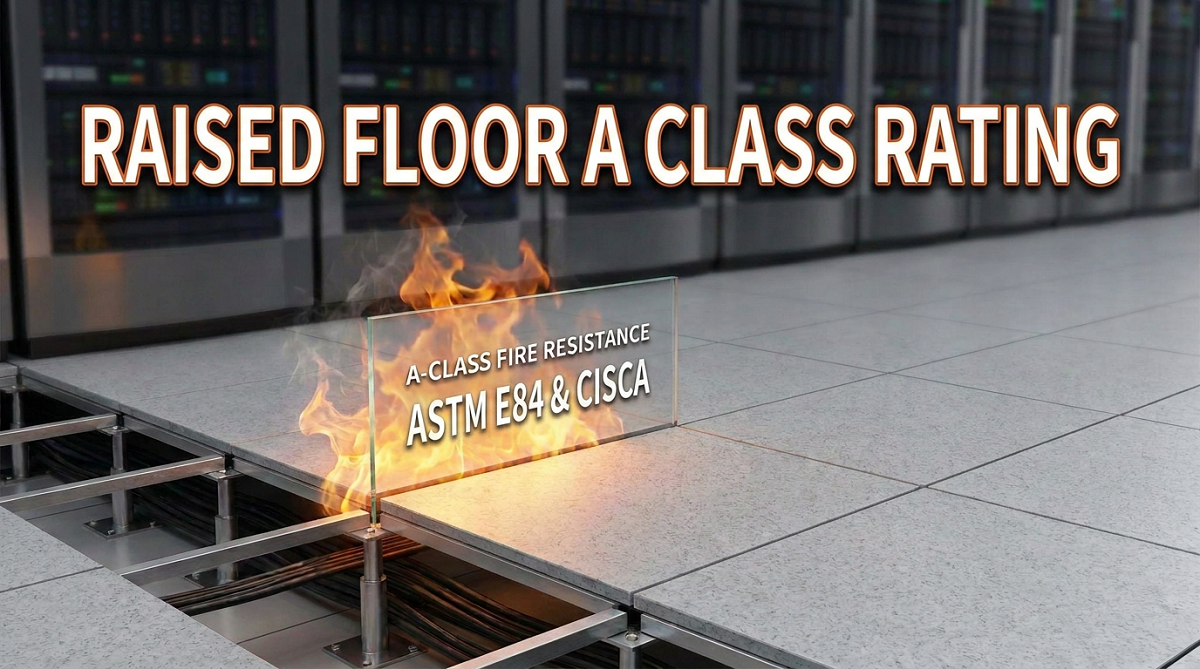
Regulatory pressure has accelerated in parallel. International frameworks such as Uptime Institute Tier certification, TIA-942 for data center infrastructure, EN 12825 for raised access floors, and LEED for Data Centers now impose stricter requirements on fire performance, VOC emissions, and material recyclability. Non-combustible flooring (Euroclass A / ASTM E84 Class A) is mandatory in Tier III and Tier IV rooms. Low-emission formaldehyde certification is becoming standard procurement language. Green data center initiatives increasingly reward recyclable and low-embodied-carbon materials, which is quietly reshuffling the competitive positioning of steel, calcium sulfate, and aluminum products.
Best ESD Floors for Data Center & Server Room in 2026
With the pressures reshaping the industry now clearly in view, the practical question becomes which flooring products actually meet the demands of 2026 workloads. The six categories that follow represent the full spectrum of viable choices on the market today, ranked from the highest-performance solutions used in hyperscale AI facilities down to the specialty options serving smaller and lighter-duty environments. Each entry examines the underlying construction, the engineering performance operators can expect in real deployments, the trade-offs that procurement teams should weigh honestly, and the room types where the product genuinely fits. Reading them as a comparative set will help clarify not just what to buy, but why one option outperforms another for a given site. For readers evaluating a specific product line to benchmark against, Huiya’s full ESD raised floor catalog covers every category discussed below and can serve as a useful technical reference throughout this section.
1. Calcium Sulfate Raised Floor with Ceramic Covering: The Reference Standard for T3/T4 and AI Facilities
Among all ESD flooring types available in 2026, calcium sulfate-cored panels with through-body ceramic surfaces represent the technical benchmark. Hyperscale operators, financial trading centers, and AI supercomputing facilities have converged on this configuration for reasons rooted in material physics.
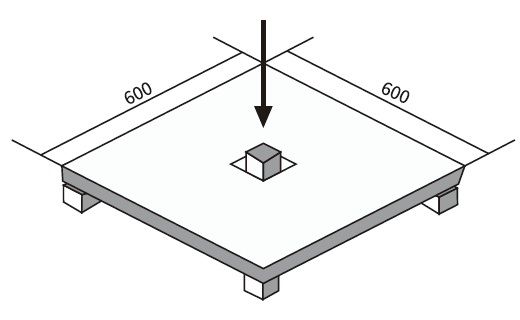
🔷Construction (600×600×32/35/38mm)
- Surface: 6 to 10mm through-body conductive porcelain tile, Mohs hardness 7, sintered with inorganic conductive powders throughout the ceramic body
- Conductive interlayer: conductive rubber pad and grid adhesive establishing equipotential bonding between surface and core
- Core: high-density calcium sulfate fiber board (α-hemihydrate gypsum plus plant fibers, hot-pressed to 1.4 to 1.6 g/cm³)
- Full perimeter: 1.2mm galvanized steel edge banding sealed on four sides
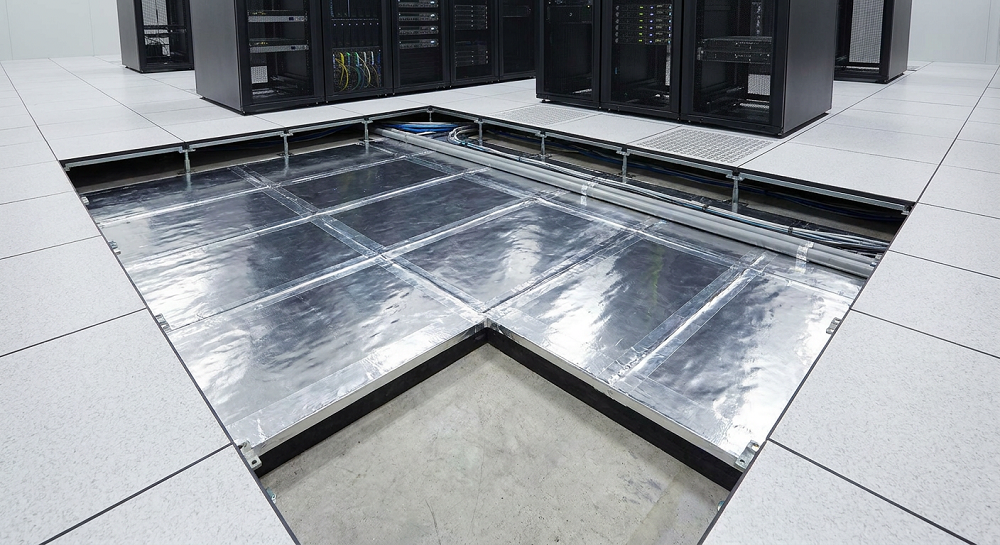
- Base: full galvanized steel bottom plate for moisture isolation and rigidity
- Support: heavy-duty adjustable galvanized pedestals plus square-steel stringers, integrated copper foil grounding grid, 300 to 600mm raised height
🔷Engineering Performance
- Fire rating: Class A, Non-combustible (Euroclass A1 / ASTM E84 Class A); withstands 700°C without cracking or releasing toxic smoke
- Load capacity: 1,650 kg/m² uniform on 38mm panels, concentrated load ≥ 900 kg
- Water absorption: ≤ 0.5%; 24-hour immersion deformation < 0.3%
- Environmental: E0 zero formaldehyde, recycled gypsum content, LEED-compatible
- Service life: 18 to 25 years with less than 5% ESD resistance drift
✅Why It Leads the Category
The value of calcium sulfate flooring lies in what it doesn’t do. It doesn’t warp under humidity changes in southern basement rooms. It doesn’t crack under thermal cycling between cold and hot aisles. It doesn’t lose its ESD properties as the surface wears, because the conductivity is built into the ceramic body rather than printed onto it. For a 24/7 facility that must operate for two decades without floor replacement, that stability translates directly into TCO advantage.
The panel’s thermal mass and dimensional rigidity also make it the preferred substrate for high open-area ventilation panels. In liquid-cooled deployments where cold aisle containment relies on precisely metered airflow, a floor that shifts or deflects under load undermines the entire thermal design.
🔶Trade-offs
- Panel weight of 22 to 26 kg increases shipping and installation labor by 30% to 40% versus steel equivalents
- Material cost carries a 30% to 50% premium over ceramic-steel alternatives
- Chipped ceramic corners cannot be spot-repaired; full panel replacement is required
✅Best Match: Tier III/IV IDC facilities, AI and GPU training centers, liquid-cooled high-density rooms, bank core trading centers, power grid dispatch centers, supercomputing labs, any 24/7 mission-critical environment where lifecycle cost outweighs initial capital.
✅Recommended product: Huiya’s calcium sulfate ceramic-faced raised access floor is engineered for exactly this class of deployment, with sealed galvanized edge banding, a copper foil grounding grid, and verified concentrated load ratings suitable for liquid-cooled AI cabinets.
2. All-Steel Raised Floor with Ceramic Covering: The Value Leader for Mid-Size IDCs
If calcium sulfate represents the top of the performance curve, ceramic-faced steel occupies the sweet spot where the vast majority of commercial IDC deployments actually land. It captures roughly 90% of the performance at 60% to 70% of the cost.
🔷Construction (600×600×40/45mm)
- Surface: 10mm through-body anti-static porcelain vitrified tile with embedded graphite conductive particles, no surface coating
- Edge: conductive PVC banding for panel-to-panel equipotential continuity
- Shell: 0.8mm top and 0.6mm bottom cold-rolled steel, drawn and spot-welded, filled with high-strength foamed cement for damping and load transfer
- Corrosion protection: internal and external epoxy powder coating
- Support: heavy-duty galvanized pedestals with stringers, 300 to 500mm raised height for downflow cooling and layered cable routing
🔷Engineering Performance
- Fire rating: Class A (both materials non-combustible)
- Wear resistance: Mohs 7, abrasion loss 0.1 g per 1,000 revolutions
- Load capacity: 1,600 kg/m² uniform on 45mm panels, concentrated load up to 1,000 kg
- Surface life: 60 years without aging on the ceramic layer; steel shell 20+ years
- Static half-decay time: < 0.5 seconds
👍What Makes It Practical
The abrasion resistance of a through-body ceramic surface is where this product earns its reputation. In rooms with frequent rack movement, forklift traffic during equipment refreshes, or high foot traffic during maintenance windows, HPL laminates begin showing wear within 3 to 5 years. Ceramic surfaces show none. The porcelain is also non-porous, so spilled coolant, oil, or dust wipes clean without staining, a meaningful advantage in liquid-cooled facilities where minor leaks are a fact of life.
Edgeless (seamless) versions have gained popularity because they eliminate the dust-trapping gaps between panels, producing a visually cleaner room and reducing particulate accumulation under cabinets.
🔁Trade-offs
- Panel weight strains upper-floor structural budgets in retrofits
- Ceramic edges chip under sharp impacts; repair requires panel replacement
- Long-term condensate exposure can corrode the underside if the epoxy coating is compromised, full-galvanized upgrades are recommended for humid regions
✅Best Match: Enterprise and government self-built server rooms (20 to 80 cabinets), standard IDC facilities, telecom operator rooms, hospital information centers, university core server rooms, medical imaging data facilities.
✅Recommended product: Huiya offers both standard and seamless (edgeless) all-steel raised floor configurations, with optional full-galvanized shells for high-humidity regions and coastal deployments.
3. Reinforced All-Steel HPL Raised Floor: The Pragmatic SMB Choice
The all-steel HPL panel is the most widely deployed ESD floor in the world. It is not the highest performer, but it remains the correct answer for a specific set of use cases where budget, timeline, and moderate performance requirements intersect.
🔷Construction (600×600×30/35mm)
- Surface: 2mm high-pressure anti-static HPL laminate with printed conductive grid, available in stone, wood, and neutral gray patterns
- Edge: black conductive PVC banding
- Shell: 0.7mm cold-rolled steel top and bottom, spot-welded and cement-filled
- Base: powder-coated for rust resistance
- Support: standard galvanized pedestals, 200 to 400mm raised height
🔷Engineering Performance
- Fire rating: B1 flame-retardant, falls short of Class A
- Load capacity: 800 kg concentrated on 35mm panels, 1,000 kg/m² uniform
- Surface life: 3 to 5 years before HPL wear becomes measurable; steel shell 15 years
- Fast installation and refurbishment turnaround
👍Where It Fits and Where It Doesn’t
For an SMB with a 10-rack computer room, a university weak-current cabinet, or a temporary transitional facility, this product delivers everything needed at the lowest possible cost. The modular construction keeps cable maintenance, expansion, and reconfiguration straightforward. Stock availability is excellent, and installation crews across the industry are familiar with it.
What it cannot do is serve a Tier III+ data center. The flame-retardant (rather than non-combustible) fire rating alone disqualifies it from core mission rooms under current codes. The surface conductivity depends entirely on the top HPL layer. Once the laminate wears through, the ESD properties collapse and the panel becomes decorative rather than functional. This creates a hidden mid-life cost that many buyers underestimate: at year 5 to 7, the entire surface must be replaced, and the labor for that replacement often exceeds the original panel cost.
🔁Trade-offs
- Flame-retardant fire rating excludes it from Tier III and higher facilities
- Surface-only ESD conductivity means functional failure follows wear
- Steel base is vulnerable to condensation-induced rust in humid environments
- Large-area installations may develop slight thermal gaps and acoustic resonance over time
✅Best Match: Small business server rooms, government weak-current rooms, university teaching labs, office central control rooms, temporary or transitional data facilities, projects where a 5 to 7 year replacement cycle is acceptable.
✅Recommended product: Huiya’s reinforced all-steel HPL raised floor is available in multiple thicknesses and surface patterns, suitable for SMB server rooms and standard weak-current environments where fast delivery and modular installation are priorities.
4. Aluminum Alloy ESD Raised Floor: The Specialty Solution for Constrained Sites
Aluminum alloy flooring occupies a narrow but important niche. It is not a mainstream commercial choice, but for certain project constraints it becomes the only viable answer.
🔷Construction
- Surface: ceramic or HPL anti-static laminate (specifier’s choice)
- Base: die-cast aluminum hollow-core panel, no cementitious filler
- Edge: integrally formed aluminum frame with full metallic conductivity
- Support: aluminum-compatible galvanized pedestals for weight parity
🔷Engineering Performance
- Fire rating: Class A (metallic non-combustible)
- Panel weight: 12 to 15 kg, approximately half of an equivalent all-steel panel
- Corrosion resistance: naturally oxide-passivated aluminum, no rust risk
- Load capacity: 700 to 900 kg concentrated, adequate for standard equipment, insufficient for heavy liquid-cooled racks
- Recyclability: 100%, highest environmental rating in the category
👍When Aluminum Wins
Three conditions justify aluminum flooring. First, structural load limits. Retrofit projects in older buildings often cannot accept the dead load of steel or calcium sulfate flooring, and aluminum’s weight advantage becomes decisive. Second, aggressive corrosion environments. Coastal facilities, chemical-adjacent labs, and cleanrooms with frequent wet cleaning benefit from aluminum’s permanent corrosion immunity. Third, cleanroom-grade applications. The absence of cement filler means no particulate outgassing, which matters for ISO Class 5 and above cleanroom certifications and precision electronics assembly.
🔁Trade-offs
- Material cost runs 2 to 3 times that of all-steel flooring
- Custom ventilation panels require longer lead times and higher tooling costs
- High thermal conductivity produces cold floor sensation in winter
- Load capacity ceiling limits use in heavy AI/GPU deployments
✅Best Match: Military cleanrooms, satellite ground control stations, precision electronics fabrication and test labs, rooftop or upper-floor data rooms with structural limits, dust-free inspection centers.
✅Recommended product: Huiya’s die-cast aluminum alloy raised floor is built for cleanrooms and load-restricted retrofits, with the option of ceramic or HPL surfaces to match specific fire and ESD requirements.
5. Conductive PVC Direct-Lay ESD Flooring: For Light-Load Learning and Training Environments
Not every room housing computers requires a raised floor. Direct-lay conductive PVC serves a different market entirely, the education, training, and light office computing sector.
🔷Construction (2mm to 3mm sheet or tile, adhered to prepared substrate)
- Top: PVC wear layer with embedded permanent carbon conductive fibers
- Middle: conductive grid layer forming a continuous drainage network
- Bottom: conductive adhesive over copper grounding foil bonded to the leveled substrate
🔷Engineering Performance
- Fire rating: B2 combustible with flame-retardant treatment; not accepted in data center halls under current international codes
- Surface resistance: 10⁶ to 10⁹ Ω
- Service life: 5 to 8 years in normal conditions
- Load capacity: light-duty only; permanent deformation under sustained heavy loads
👍Where It Belongs
For a school computer classroom or corporate training room, direct-lay PVC is the correct choice for reasons that have nothing to do with data center performance. Students and trainees stand and walk on it for hours; the soft underfoot feel reduces fatigue. Installation is fast, a classroom can be completed in a weekend. The seamless sheet form produces an attractive, unified appearance in patterns from wood grain to stone. And the per-square-meter cost allows entire buildings to be outfitted within tight education budgets.
What it cannot do is serve as data center flooring. Without an underfloor plenum, downflow cooling is impossible. The fire performance fails data center inspections. Heavy racks produce permanent indentation, and heat from continuous server operation accelerates aging.
✅Best Match: K to 12 and university computer classrooms, corporate PC training rooms, small office reception computing areas, temporary demonstration rooms.
✅Recommended product: Huiya’s conductive PVC direct-lay flooring is available in sheet and tile formats with permanent carbon-fiber conductivity, suitable for classrooms, training rooms, and light office computing spaces.
6. Through-Body Conductive Anti-Static Tile: For Small Rooms Without Cabling Requirements
The final category is through-body conductive porcelain tile mortared directly to the substrate. It exists at the opposite extreme from raised flooring, no underfloor space, but permanent performance.
🔷Construction:
8 to 10mm through-body conductive porcelain tile, cement-mortared to the prepared floor, with copper grounding mesh bonded beneath.
🔷Engineering Performance
- Fire rating: Class A, Non-combustible
- Service life: 30+ years
- Wear resistance: extreme
✅Strengths and ⛔Limits
The tile is essentially permanent. It is fireproof, wear-resistant, maintenance-free, and immune to ESD degradation because the conductivity is built into the ceramic body. But without an underfloor plenum, cable routing must be surface-mounted or wall-based, and downflow cooling is not possible. Installation is slow and demands an exceptionally flat substrate.
✅Best Match: Small monitoring rooms, duty control rooms, equipment operation booths. Never actual server halls.
✅Recommended product: Huiya’s through-body conductive anti-static porcelain tile is available in multiple thicknesses and finishes for permanent installations in control rooms and monitoring booths.
2026 Data Center Floor Purchasing Checklist – Non-Negotiable Technical Thresholds
Before signing any purchase order, verify each product against these non-negotiable thresholds:
| Parameter | Requirement |
|---|---|
| Surface resistance | 10⁶ to 10⁹ Ω per IEC 61340-4-1 / ANSI/ESD S7.1 (reject any product relying on sprayed conductive paint) |
| Concentrated load, standard server room | ≥ 800 kg |
| Concentrated load, high-density/liquid-cooled | ≥ 1,000 kg |
| Fire rating, core data center | Non-combustible (Euroclass A1/A2 or ASTM E84 Class A) mandatory |
| Grounding system | Galvanized pedestals + stringers + copper foil grid, total resistance ≤ 10 Ω |
| Ventilation panel open area | 15% to 40%, matched to rack heat density |
| Formaldehyde emissions | Low-emission certified (CARB Phase 2 or equivalent) |
| Long-term ESD drift | < 5% over specified service life |
Flooring to Avoid for Data Center & Server Room in 2026
The industry has moved beyond several legacy products. Buyers still encountering these in bids should push back:
- Wood-core or particle-board ESD panels: moisture absorption, poor fire performance, low load ratings, obsolete
- Thin PVC-laminated steel panels: laminate delamination within 1 to 3 years, rapid ESD failure, high replacement labor cost
- Direct-lay epoxy ESD coatings: no underfloor space for cabling or airflow, appropriate only for industrial workshops
Huiya Real-Time News
Huiya Real-Time News is dedicated to providing you with the latest and most authoritative information on the raised flooring industry.
We provide 24/7 updates on industry policy interpretations, market trend analysis, company news.
MORE DOWNLOADS

GENERAL CATALOGUE
HUIYA INTRODUCTION

HUIYA GREEN LABEL
CAD/BIM FULL STEEL
APPLICATION SCENARIOS


