

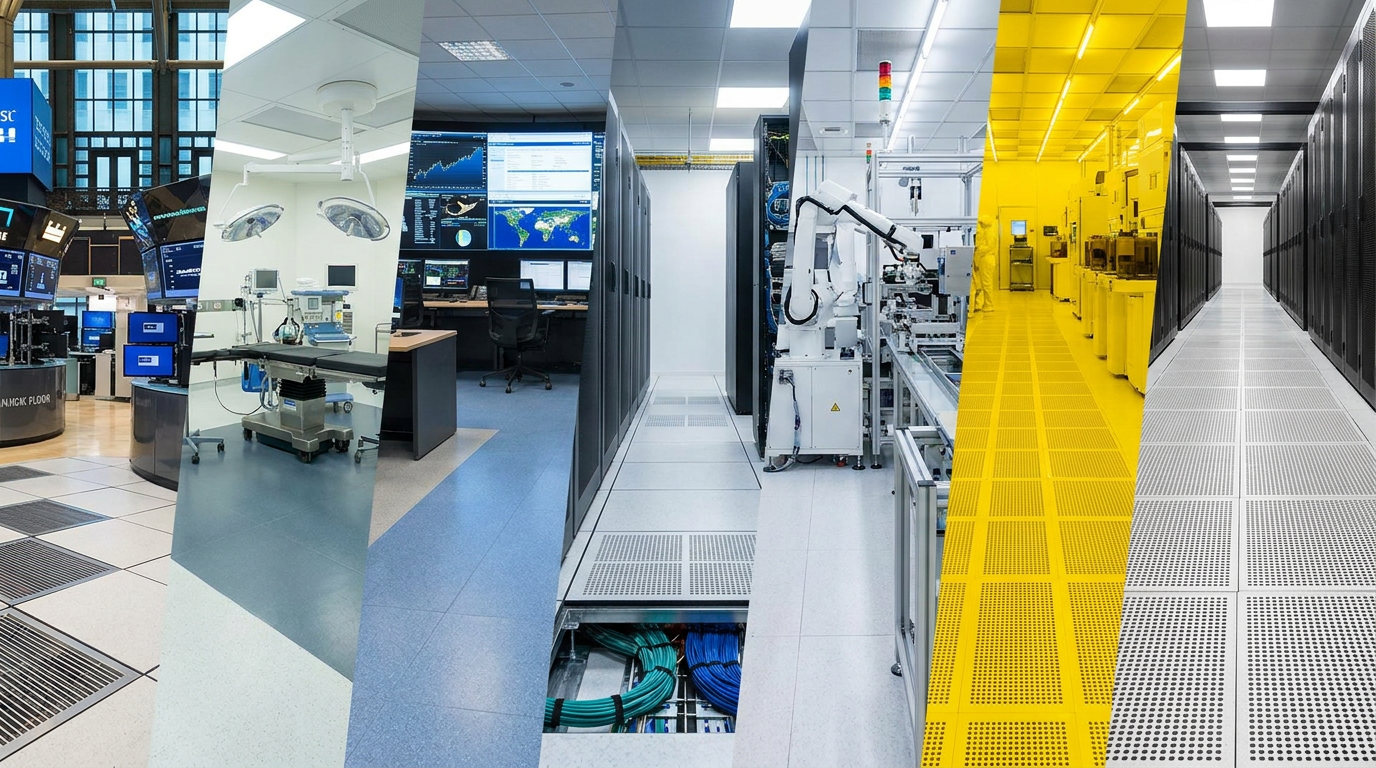
Huiya has been rooted in the anti-static flooring industry for 20 years. From our early days doing on-site installation, to product selection consulting, site surveys, and post-installation evaluations, and now to full-lifecycle technical support, we’ve participated in over 400 projects, serving clients across finance, healthcare, government, telecommunications, precision manufacturing, semiconductors, and data centers.
Our service model has evolved, but our commitment to sound technical judgment has never wavered. Our project managers still personally conduct site surveys, participate in incident evaluations, and calculate TCO for clients. Because there’s one truth in this industry that only teams who have literally crouched in server rooms and knelt beneath raised floors across hundreds of projects truly understand:
❗“The cheapest anti-static flooring” is one of the most expensive procurement decisions in this industry.
This isn’t a marketing slogan. It’s a pattern Huiya has witnessed, dissected, and explained to clients hundreds of times over 400+ real-world projects. We’ve seen brokerage data centers collapse at 2 AM. We’ve seen hospital imaging departments forced to suspend services due to resistance drift. We’ve seen semiconductor clients lose more in a single month of yield decline than the entire “savings” from their original procurement. At every post-incident review, the client’s expression is almost identical – regret, the specific kind of regret that says, “If only I’d spent a little more back then.”
Today, Huiya wants to share these accumulated observations from an engineer’s perspective, and lay this account out clearly for you.
A Recurring Industry Pattern
Let’s start with some rough data compiled by Huiya. Of the 400+ projects we’ve handled or followed, roughly 90 clients explicitly chose the “lowest-bid option” (more than 25% cheaper than comparable alternatives) during procurement. Among these 90 clients:
- ~60% experienced problems within 5 years; surface warping, unstable resistance, pedestal corrosion, localized subsidence, etc.
- ~25% required large-scale rework or complete replacement within 3–8 years, with average rework costs of 2.3x the original procurement price
- ~12% experienced business-impacting incidents due to flooring failures, cabinet tilting, server damage, production line shutdowns, cleanroom contamination
- Only ~3% of “lowest-bid” solutions successfully served their full expected lifespan
By comparison, among clients who chose mid- to high-end solutions, the incident rate within 5 years was below 8%. The contrast is striking. But what’s even more striking is that nearly every client who chose the lowest-bid solution, during post-incident reviews, said the same sentence:
“I should have just spent a little more back then.”
The Most Memorable Client Lessons
Without naming specific companies, here are the recurring patterns Huiya has observed over the years.
🔶1. Core Data Centers at Financial Institutions
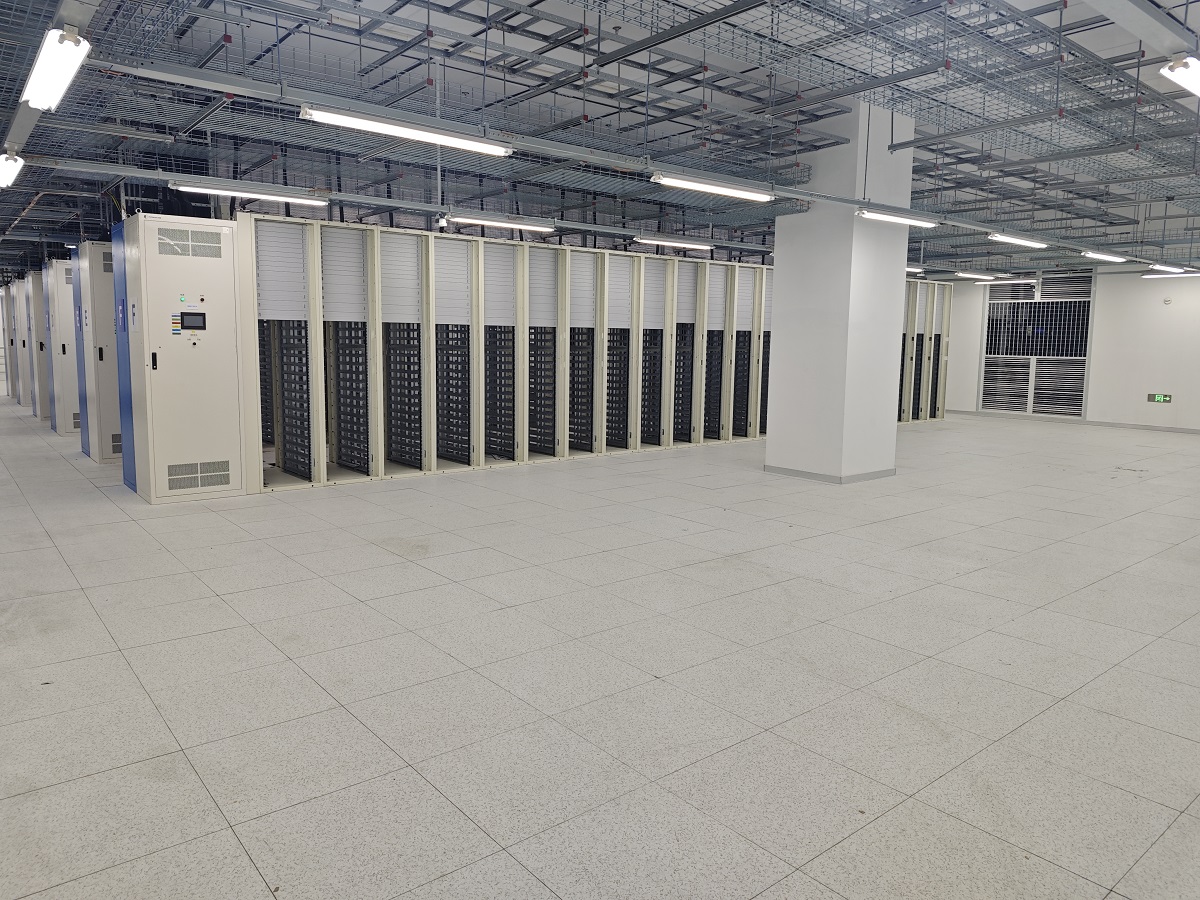
This is the highest-cost failure scenario Huiya has witnessed. For brokerage and banking data centers, a single unplanned outage often costs millions. Yet a significant portion of these clients still initially chose solutions that were 30%–40% cheaper.
The most common failure pattern: after 3–5 years of service, cabinet upgrades introduce high-density storage racks weighing 1–1.5 tons each. Older all-steel flooring lacks the load reserve and begins to sag, causing cabinet tilting, cable strain, and even equipment damage.
The few hundred thousand saved during procurement gets paid back, many times over, in a single incident. This ratio is almost universally acknowledged in finance, yet new clients repeat the mistake every year.
🔶2. Class-A Hospital Information Centers and Imaging Departments
The complexity here is that server rooms, imaging (CT/MRI), operating theaters, and ICUs each have completely different flooring requirements, but many hospitals apply “one-size-fits-all” low-cost products during procurement.
The result: high-traffic imaging areas show visible wear and denting within 3 years; CT rooms suffer image interference lines due to unstable resistance; operating theaters fail antimicrobial requirements entirely. Every fix requires localized rework, and in a hospital environment, rework means the compound cost of “service suspension + relocation + reinstallation.”
🔶3. Semiconductor and Precision Manufacturing Facilities
This is the most demanding environment for static control—and paradoxically, one of the deepest “low-price traps.”
Semiconductor fabs require enormous flooring quantities (often 10,000+ m²), so procurement teams face intense cost-reduction pressure. Huiya has seen several clients save a few million on procurement by choosing solutions with “similar-looking” specifications. The result: six months into production, surface resistance batch inconsistency caused wafer yield to drop by 1.8 percentage points.
For a semiconductor fab, that 1.8% yield loss consumes the entire flooring savings in a single month, and the bleeding continues until it’s fixed.
🔶4. Government and Public Sector Data Centers
These clients bear the historical burden of “lowest-bid-wins” tendering. Their procurement rules are extremely sensitive to upfront price and lack tools to evaluate lifecycle cost.
The recurring result: a government cloud data center runs for 6–8 years before systemic aging appears: pedestal corrosion, surface bulging, and resistance drift emerging simultaneously. Full replacement requires evacuating the entire server room, migrating hundreds of servers, and often takes months. The total cost is 5–10x the “savings” from the original procurement.
🔶5. Emerging Industries: New Energy and Biopharma
Recent years have brought more clients from battery labs, GMP pharmaceutical cleanrooms, and lithium battery pack lines. What they share: rapidly evolving standards for cleanliness and static control.
A typical scenario: clients select mid-to-low-tier products based on current standards, only to find the flooring can’t keep up after 2–3 years when standards rise or production lines upgrade. Even if the product itself hasn’t failed, it must be replaced early. For these industries, Huiya generally recommends investing higher upfront to preserve 5–10 years of future technical headroom.
Three Hidden Costs of Cheap Anti-Static Flooring
After hundreds of post-incident reviews, Huiya has found that failures with cheap flooring almost always cluster around three technical dimensions:
✅1. The Gap Between “Rated” and “Actual” Load Performance
The biggest problem with low-cost products: specs are printed, not measured.
Premium product lines conduct third-party CMA/CNAS testing and reserve 25%+ safety margins on factory load ratings. In contrast, many low-cost products show up to 30% deviation between rated and actual load values. The gap isn’t visible when cabinets are first installed, but sagging begins within a year, and by year two, you’re facing the failures described above.
How to verify: Require suppliers to provide third-party test reports from the last 3 months, not a generic marketing document that’s been used for three years.
✅2. Batch-to-Batch Stability of Surface Resistance
The core function of anti-static flooring is to safely dissipate static charge, with surface resistance stabilized between 10⁶–10⁹ Ω.
Low-cost suppliers typically only test the first unit – the first tile passes, and the rest is a gamble. Huiya has used multimeters on-site to test certain low-cost brands and found that over 20% of tiles within the same batch of 100 fell outside the acceptable resistance range. For precision electronics, financial trading, medical imaging, and cleanroom environments, this is a ticking time bomb.
How to verify: Require suppliers to provide per-batch sampling records, not just a single model certificate.
✅3. Corrosion Resistance of the Pedestal System
Many clients only look at the panels, not the pedestals. This is the single most common procurement blind spot.
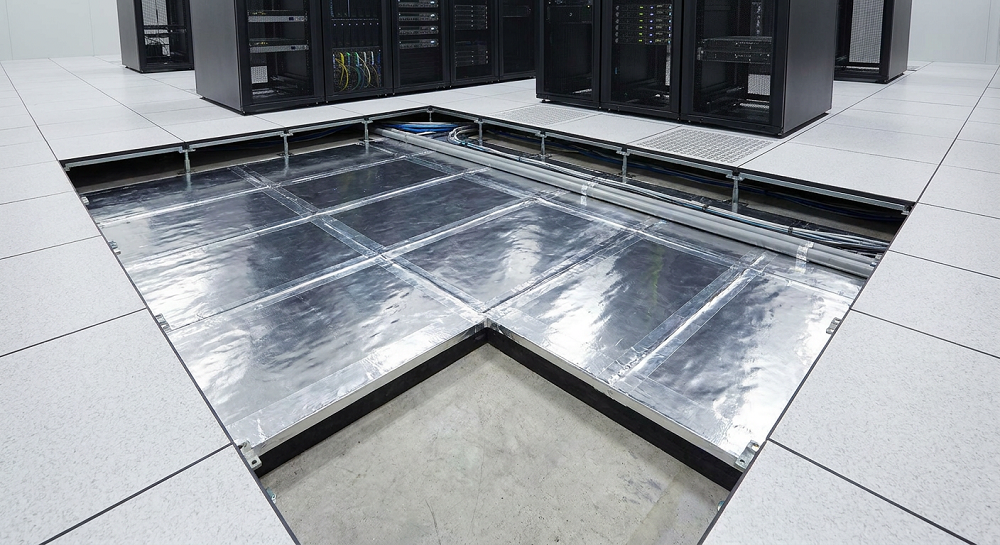
Low-cost pedestals use standard galvanized steel, which begins corroding within 3–5 years in humid or sulfur-containing environments (common in southern China). Pedestals with electrophoretic coating and cathodic protection typically have a 20+ year design life. The critical issue: replacing pedestals is far harder than replacing panels, you have to evacuate the entire server room. The replacement cost is 20x+ the original pedestal price difference.
How to verify: The contract must explicitly specify pedestal material grade, surface treatment process, and corrosion resistance rating.
✅The moment you sign with a low-cost supplier is the moment hidden costs begin accruing.
The TCO Framework: Huiya’s Six Evaluation Dimensions
TCO (Total Cost of Ownership) is Huiya’s core tool for technical solution design. When the same set of products is compared using TCO, the conclusion often flips completely from the initial price comparison:
- ① Unit price per m² – The most intuitive but most misleading number.
- ② Rated vs. actual load performance – Focus on the recency and accreditation of third-party test reports.
- ③ Batch stability of surface resistance – Quality suppliers provide per-batch sampling records.
- ④ Pedestal material grade and corrosion life – This determines whether you’ll need to replace everything in 10 years.
- ⑤ After-sales response time – Whether the supplier will contractually commit to specific response and on-site times.
- ⑥ Annualized lifecycle cost – Total investment ÷ actual service years = the real annual cost.
Typical Selection Comparison Model
Here’s a model Huiya frequently uses, a 1,800 m² core data center project with three typical solutions, evaluated over a 15-year cycle:
| Tier | Product Type | Unit Price (USD/m²) | Initial Total |
|---|---|---|---|
| Low-end | Standard all-steel ESD | $36 | $65,000 |
| Mid-range | Ceramic ESD | $53 | $95,000 |
| High-end | Calcium sulfate core (e.g., Huiya SP45 tier) | $72 | $130,000 |
Most procurement decisions favor the mid-range option, reasonable price, seemingly “safest.” But once you calculate the full 15-year lifecycle cost, the conclusion flips entirely:
- Low-end: Concentrated load capacity fails at year 3 → localized reinforcement ≈ $25,000. Pedestal corrosion at year 8 → full replacement ≈ $76,400. 15-year TCO ≈ $166,400
- Mid-range: Ceramic surface is fragile; ~20% of tiles need replacement within 10 years in high-traffic areas ≈ $19,400. Pedestal replacement at year 12 ≈ $38,900. 15-year TCO ≈ $153,300
- High-end: 20-year warranty covers the full cycle. Estimated maintenance ≈ $4,200. 15-year TCO ≈ $134,200
The seemingly most expensive option ends up as the cheapest over 15 years. The key differentiator isn’t the surface material itself, it’s the load reserve, batch stability, and pedestal lifespan. These three factors determine whether the entire system needs mid-life overhaul.
This isn’t theoretical, it’s a conclusion Huiya has verified across dozens of projects. Among clients who complete a full 15-year TCO analysis, fewer than 15% ultimately choose the “lowest-bid” solution.
When Premium Flooring Is Genuinely Worth It
Not every project needs the highest-tier product. Huiya’s advice is consistent: look at the scenario first, then the budget.
A rough tiering guide:
- Office areas, standard meeting rooms → Mid-tier all-steel ESD is sufficient. Premium products here are wasted.
- Monitoring rooms, distribution rooms, teaching labs → Mid-tier ceramic or standard calcium sulfate meets requirements.
- Core data centers, financial trading systems, hospital ICUs/imaging centers, cleanrooms, precision manufacturing → These are zero-tolerance-for-error environments. High-end calcium sulfate or composite core products deliver real value.
The premium on high-end product lines (including Huiya SP45 and comparable solutions) is essentially the cost of certainty—the certainty that nothing will go wrong. This certainty only delivers real value in environments where downtime costs are extreme and failures are irreversible.
The point isn’t “choosing the expensive one”, it’s “choosing the right one.”
Three Hard Metrics to Judge Whether “Expensive” Is Worth It
Honestly, not every high-priced anti-static floor deserves its price tag. Some brands’ premiums go into channel margins and sales commissions rather than the product itself.
Huiya evaluates whether a premium price is justified using three criteria:
- Does the supplier provide recent third-party test reports? Per-batch documentation, not a “universal report” used for three years running.
- Does the contract include specific response times and warranty periods? True premium product lines commonly offer 15–20 year warranties.
- Can the supplier provide verifiable industry case studies? Real, on-site-visitable projects, not brochure renderings.
Only when all three are satisfied is it a genuine premium product. If any are missing, the premium’s legitimacy needs reevaluation.
Huiya’s 20-Year Conclusion and Professional Recommendation
Twenty years, 400+ projects, and Huiya’s deepest realization is this:
Every yuan saved when purchasing anti-static flooring will be repaid, at some future moment, in a far more expensive form.
The rule isn’t absolute, there’s always the lucky 3%, but for the vast majority of critical scenarios, the probability is too high to gamble on. Financial institutions have bet. Hospitals have bet. Semiconductor fabs have bet. Government clouds have bet. Every final invoice has been heavy.
Huiya can’t change the tendering inertia toward “lowest-bid-wins.” But before a client places an order, we can help them run the numbers clearly. That’s why Huiya, from on-site installation twenty years ago to today, has never abandoned rigorous technical judgment.
So before you approve that “lowest-bid” anti-static flooring quote, please ask yourself three questions:
- What is the annualized cost over a 20-year lifecycle?
- What is the actual business loss from one data center outage / service suspension / production halt?
- Are this supplier’s clients from three and five years ago still using their products today?
If you can’t answer these three questions, don’t place the order.
✅The cheapest anti-static flooring was never actually cheap. It simply hands you the bill in a different form, usually delivered late, so late that you can no longer recover.
The observations and data in this article are based on Huiya’s practical experience from participating in over 400 projects between 2013 and 2026. Market conditions fluctuate with raw material costs, exchange rates, and transportation costs; please conduct a TCO assessment for each specific project based on its actual circumstances.
About Huiya: Huiya has focused on antistatic flooring and data center infrastructure solutions for 20 years, serving over 400 clients in industries such as finance, healthcare, government, telecommunications, semiconductors, and new energy. We provide selection consultation, on-site surveys, TCO calculations, and full lifecycle technical support from an engineer’s perspective, helping clients make the right purchasing decisions, not just the most expensive ones, in critical scenarios.
Huiya Real-Time News
Huiya Real-Time News is dedicated to providing you with the latest and most authoritative information on the raised flooring industry.
We provide 24/7 updates on industry policy interpretations, market trend analysis, company news.
MORE DOWNLOADS

GENERAL CATALOGUE
HUIYA INTRODUCTION

HUIYA GREEN LABEL
CAD/BIM FULL STEEL
APPLICATION SCENARIOS


