

On August 10, 2026, the General Manager of Changzhou HUIYA Decoration Materials Co., Ltd. (HUIYA) led a delegation of two QC engineers and several technical staff on a dedicated visit to the SGS third party testing institute in Changzhou. The purpose of the visit was to systematically study and observe on site the testing methods used for raised access floors under the two mainstream systems of CISCA 2007 (American standard) and EN 12825:2001 (European standard).
Raised access floors are widely applied in data centers, financial computer rooms, cleanrooms, command and control centers, and high end office spaces. Their load bearing performance and long term stability directly affect the safety of the equipment placed above, the efficiency of cabling maintenance, and the overall cost of operations. For many years, HUIYA has carried out multi standard sampling inspections on finished products before shipment, covering GB/T 36340-2018 (Chinese national standard), CISCA 2007 (US standard), BS EN 12825:2001 (European standard), KS F 4760 (Korean standard) and JIS A 1450:2005 (Japanese standard). Details can be found in the HUIYA “Pre Delivery Sampling Inspection Test Report” shown below. This visit to SGS was aimed at further aligning HUIYA with the operational details used by international laboratories, so that the testing procedures of an external authority can be replicated inside HUIYA’s own laboratory, achieving methodological consistency between internal and external inspections.
1. CISCA 2007 US Testing Method: Centered on Point Load and Deflection Control
Under the guidance of SGS engineers, the HUIYA team observed on site the complete testing procedure for raised access floors defined by CISCA (Ceilings and Interior Systems Construction Association). Key learning points included:
- Concentrated Load Test
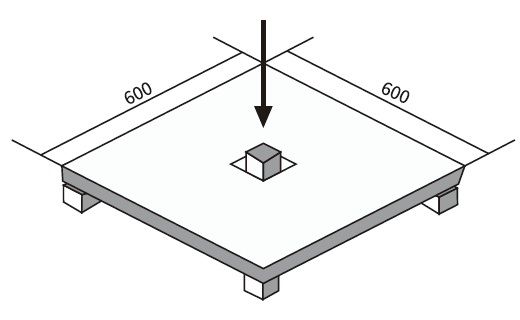
A square loading head with a footprint of 1 square inch (approximately 25 mm by 25 mm) is used to apply loads at four characteristic positions on the panel:- Point A: Panel Center
- Point B: Panel Center (verification in a second direction)
- Point C: Panel 1/4 Point
- Point D: Corner Point, at a position 70 mm by 70 mm from the corner
- Stepped Loading Sequence: Loads are increased in stages, starting at 1980 N (445 lb), then 3560 N (800 lb), 4450 N (1000 lb), and progressively up to 22241 N (5000 lb), corresponding to the five CISCA classes of Light Duty, Standard, Heavy Duty, Extra Heavy Duty and Ultra Heavy Duty.
- Deflection and Permanent Set Readings: During loading, the instantaneous deflection is recorded synchronously. After unloading, the panel is left to rest, and the residual deformation is measured to evaluate the elastic recovery capacity of the floor under the designed load.
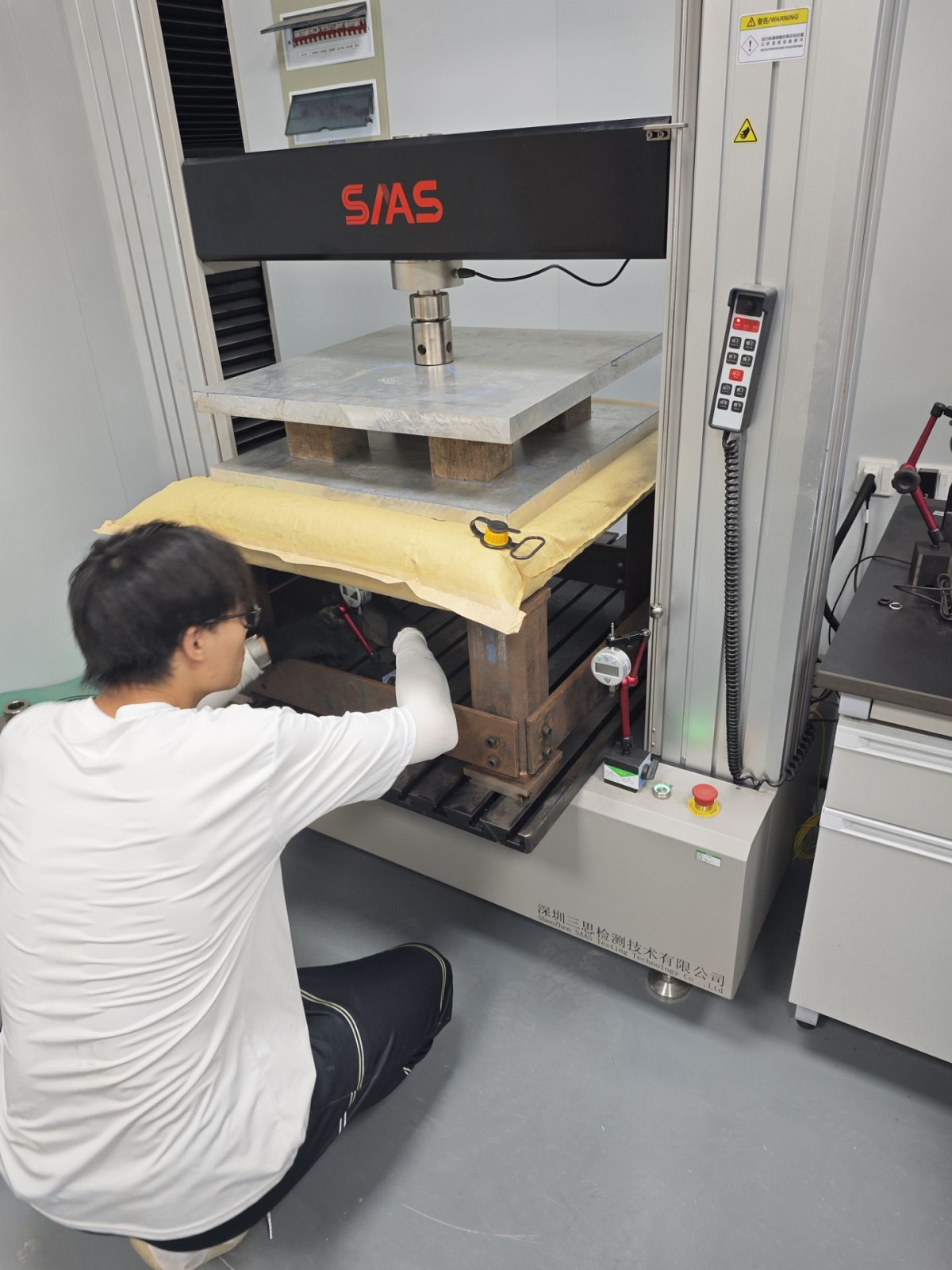
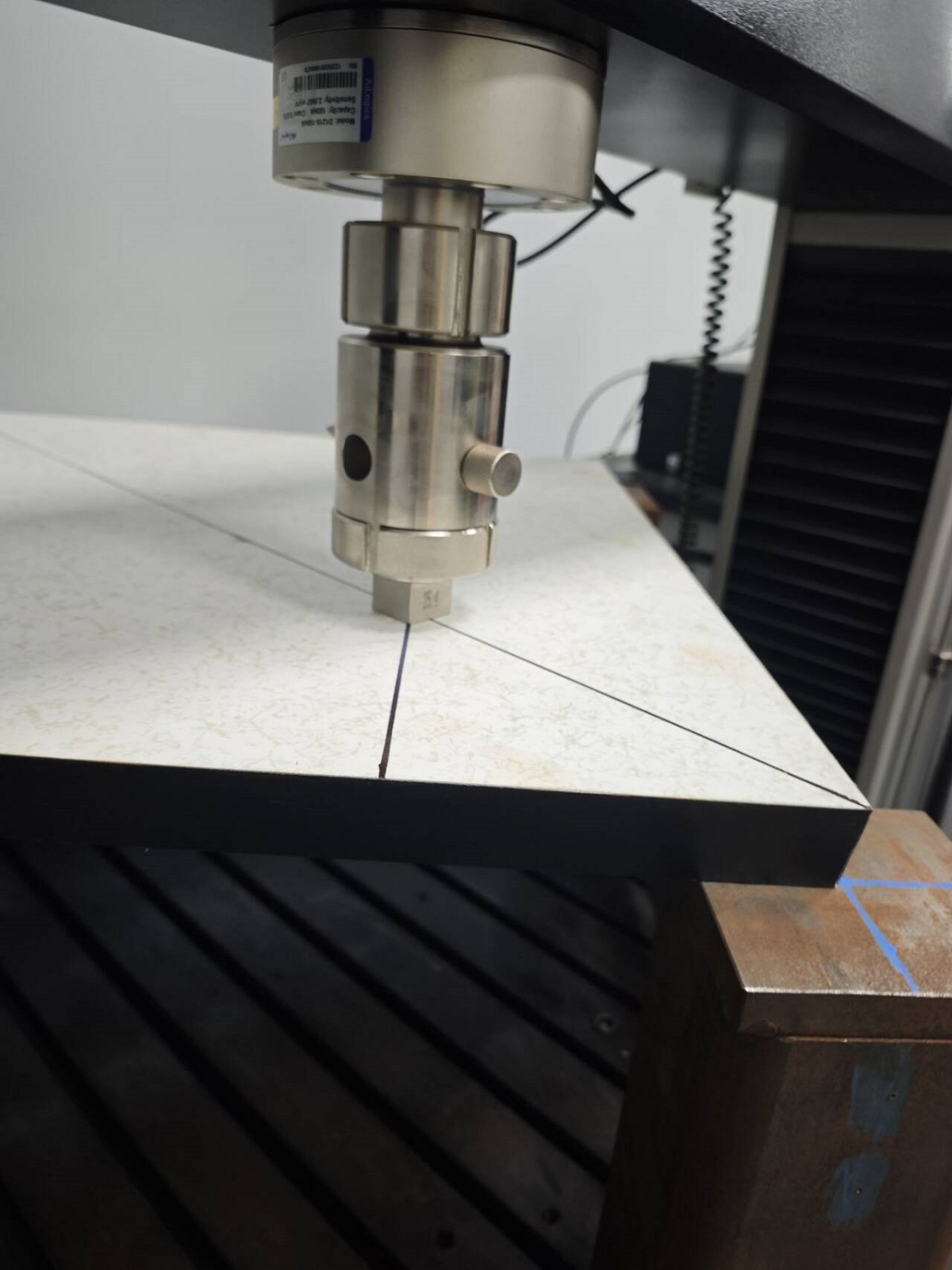
The SGS site uses a SAS electronic universal testing machine equipped with a high precision load cell (Model D1210-GBA class). The loading head is aligned with the marked cross point, while a displacement gauge on the side collects data synchronously. The full loading, holding and unloading curve is automatically recorded by software, producing a traceable test report.
2. EN 12825 European Testing Method: Centered on Load Classification and Safety Factor
EN 12825 is the European general specification for access floors. It classifies floors into Class 1 through Class 6 according to load bearing capacity, and defines two key indicators:
- Working Load: the load that the floor should repeatedly withstand in service.
- Ultimate Load and Safety Factor: the ultimate load should be at least twice the working load, in order to provide safety redundancy during use.
At the SGS site, the HUIYA team focused on the following aspects:
- Four Corner Support Constraint of the Sample: grooved steel supports are used to simulate the boundary conditions of a panel resting on pedestals in real service. The photos clearly show the rust colored heavy duty steel clamps and the T slot base.
- Loading Head Specification and Loading Rate: EN 12825 requires a 25 mm by 25 mm square indenter. The loading rate is kept stable to avoid impact effects that could disturb the results.
- Difference Between Center Point and Corner Point Tests: the center point test evaluates the overall bending performance of the panel, while the corner point test evaluates the shear and warping resistance of the overlapping edge.
- Deflection Limit: the deflection under working load is generally required to be less than or equal to 2.5 mm. During testing, a lateral displacement gauge provides real time readings, and the original curve is preserved.
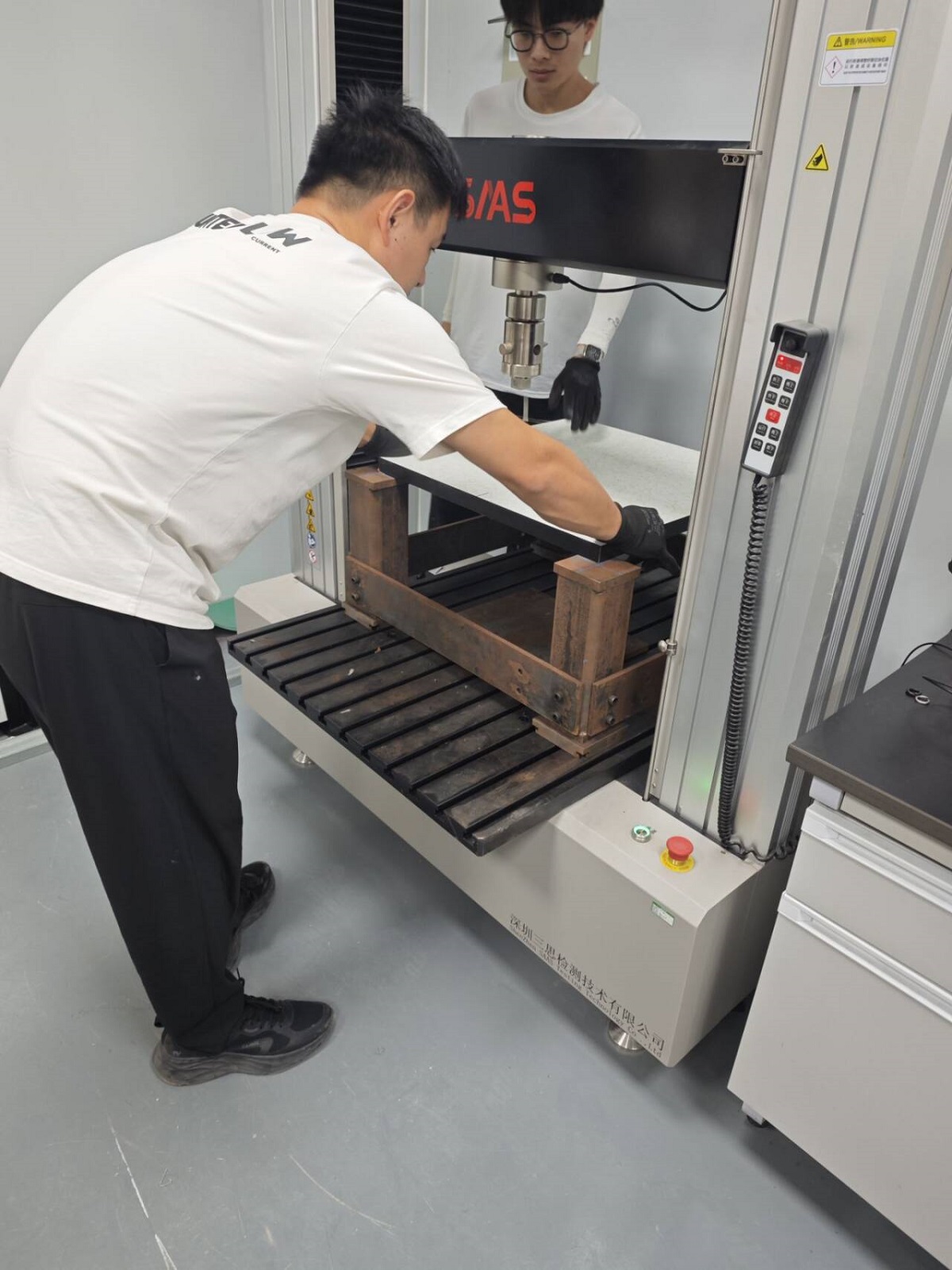
3. Test Environment Control: Synchronous Monitoring of Temperature, Humidity and Atmospheric Pressure
Test results for raised access floors are relatively sensitive to environmental conditions. During the visit, the HUIYA team paid special attention to how the SGS laboratory controls its environment. A Testo 622 temperature, humidity and atmospheric pressure recorder was used on site, and the measured conditions were:
- Ambient temperature: 26.5 °C
- Relative humidity: 73.7 %RH
- Atmospheric pressure: 1008.7 hPa
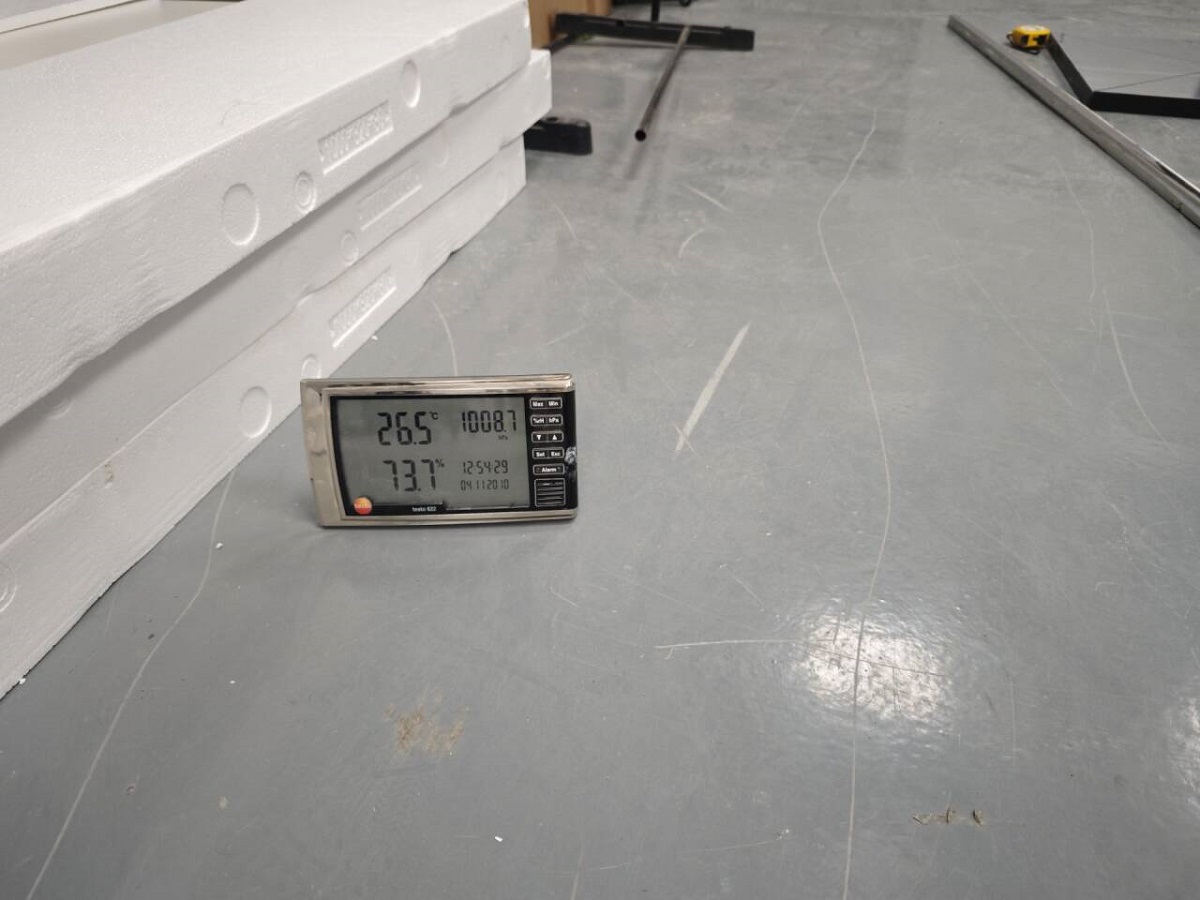
These data are archived in the test report as environmental parameters, ensuring that the test results are comparable and reproducible. HUIYA will follow the same practice by equipping its own laboratory with environmental recording devices of the same specification, and by incorporating temperature and humidity data into the original records of every pre delivery inspection report.
4. Bringing the “Third Party Inspection” Into the HUIYA Laboratory
This visit was not a simple tour, but a full process learning experience covering fixtures, clamps, loading paths, data acquisition and report output. After returning to Changzhou, the HUIYA team will drive implementation along the following directions:
- Equipment Benchmarking: using the electronic universal testing machine and load cell specifications observed at SGS as a reference, HUIYA will upgrade the loading equipment, displacement gauges and data acquisition system in its own laboratory.
- Fixture Standardization: dedicated support fixtures will be manufactured and calibrated in accordance with CISCA 2007 and EN 12825, covering the center point, 1/4 point and corner point test positions of mainstream 600 mm by 600 mm panels.
- Documented Testing SOP: the loading sequences, holding times, reading nodes and judgment thresholds of the two standards will be incorporated into the “Raised Access Floor Finished Product Inspection Work Instruction”, so that every panel coming off the line can be re inspected internally following the same methodology.
- Higher Sampling Coverage: based on the existing load test positions in the “Pre Delivery Sampling Inspection Test Report” (Panel Center Point A and B, 1/4 Point C, 70 by 70 Corner Point D), together with optional destructive tests, conductivity tests (1 × 10¹⁰ to 1 × 10¹⁰ Ω at 500 V) and visual inspection (length and width 599.6 to 600 mm, height tolerance ± 0.3 mm, initial flatness edge less than 0.5 mm, diagonal less than 0.75 mm), sampling ratios and batch traceability mechanisms will be further optimized.
- Personnel Training: QC engineers will be regularly sent to SGS for method comparison trials, ensuring that any deviation between internal inspection data and third party data stays within a reasonable range.
5. HUIYA High Quality Raised Access Floor Assurance
For HUIYA, a raised access floor is not simply a decorative material, but a “second ground” that carries precision equipment and mission critical operations. Load bearing capacity, deflection, permanent set, antistatic performance, dimensional stability and edge strength. Behind every one of these parameters lies the operational safety of a customer’s computer room or office space.
Bringing the SGS third party testing model into HUIYA’s own laboratory means that every product completes a full “close to third party” health check before it leaves the factory. This is HUIYA’s ongoing respect for the Chinese national standard GB/T 36340-2018, the US standard CISCA 2007 and the European standard EN 12825, and it is also a concrete way of honoring the promise made to every customer.
HUIYA will continue to use international standards as its methodological baseline, and stable quality data as its language, working together with customers, design institutes, general contractors and third party testing institutes to push the Chinese raised access floor industry toward a more standardized and more traceable future.
Quality Control Department, Changzhou HUIYA Decoration Materials Co., Ltd.
Related posts:
Qiode Import & Export Trading Co., Ltd. Sets Sail | Huiya Raised Access Flooring's New Global Ex...
HUIYA × OKB Bank Chief Rep Visit Shanghai Shanglun Wood Industry | Sourcing Premium China Furniture ...
HUIYA Visits PVC TRIM Extrusion Supplier to Jointly Advance the Customized Design and Development of...
Huiya Real-Time News
Huiya Real-Time News is dedicated to providing you with the latest and most authoritative information on the raised flooring industry.
We provide 24/7 updates on industry policy interpretations, market trend analysis, company news.
MORE DOWNLOADS

GENERAL CATALOGUE
HUIYA INTRODUCTION

HUIYA GREEN LABEL
CAD/BIM FULL STEEL
APPLICATION SCENARIOS


