Innovative and Reliable Raised Access Floor Enterprise
HUIYA Completes JIS A 1450 Testing Equipment and Achieves Japanese Standard Compliance For Japan’s OA Floor Market
Home/News/HUIYA Completes JIS A 1450 Testing Equipment and Achieves Japanese Standard Compliance For Japan’s OA Floor Market
Huiya Access Floor Completes JIS A 1450 Testing Equipment and Achieves Japanese Standard Compliance, Empowering Expansion into Japan’s OA Floor Market
As Huiya’s raised access floor products continue to expand their influence in the Japanese market, quality requirements have grown increasingly demanding. Japan, being one of the world’s most mature markets for raised access floors (OAフロア / Free Access Floor), has established JIS A 1450 – the Test Methods for Raised Access Floor – issued by the Japanese Standards Association (JSA) and jointly promoted by the Japan Access Floor Association (JAFA / 日本フリーアクセスフロア工業会). It is globally recognized as one of the most systematic and rigorous testing systems in the industry.
To better serve Japanese customers and to apply the same level of quality control to domestic projects, Changzhou Huiya Decoration Materials Co., Ltd. has fully established eight categories of testing laboratory equipment in accordance with JIS A 1450:2021 and JAFA’s Performance Evaluation of Free Access Floor requirements. These cover every performance dimension of raised access floors, from dimensions to seismic resistance, from static to dynamic, and from structural to electrical safety.
This article details each test based on the core provisions of JIS A 1450 and the actual testing scenarios at Huiya’s laboratory.
I. Overview of JIS A 1450:2021
JIS A 1450, issued by the Japanese Standards Association (JSA), is the Test Methods for Free Access Floor and serves as the core reference for product performance evaluation by the Japan Access Floor Association (JAFA). The standard specifies test methods and evaluation criteria across eight major categories – dimensional measurement, static load, impact, rolling load, combustion, electrostatic propensity, leakage resistance, and seismic vibration – and represents an essential technical entry threshold for OA floor products in the Japanese market.
1.1 Standard Information
Item
Content
Standard No.
JIS A 1450:2021
Issue Date
2021-11-22 (replacing the 2015 edition)
Full Title
Test Methods for Raised Access Floor
Issuing Bodies
Japanese Standards Association (JSA) + Japan Access Floor Association (JAFA)
❌ Not Applicable: Direct-laid PVC sheet, epoxy self-leveling, flat-laid rubber flooring, or any non-removable flooring.
1.3 Eight Performance Categories Covered by JIS A 1450
Performance
Test Method
Application Scenario
Dimensions
Dimensional Measurement
Geometric precision control
Static Load
Static Load Test
Bookshelves, equipment loads
Impact
Impact Test
Falling object protection
Rolling Load
Rolling Load Test
Carts, transport vehicles
Non-combustibility
Combustion Test
Underfloor cable fire risk
Electrostatic
Charging Test
Walking-induced static control
Leakage Resistance
Leakage Resistance Test
Electrical safety
Seismic
Vibration Test
Earthquake evacuation safety
Huiya has procured and calibrated all required equipment, with full capability to issue complete in-house JIS A 1450 inspection reports. All Huiya HY-OA series products fall within the full coverage of JIS A 1450:2021.
II. Detailed Explanation of Eight Testing Items at Huiya Laboratory (per JIS A 1450:2021)
In accordance with the requirements of JIS A 1450 standard, Huiya has equipped and debugged the following testing equipment:
① Appearance / Dimensional Inspection
Test Content:
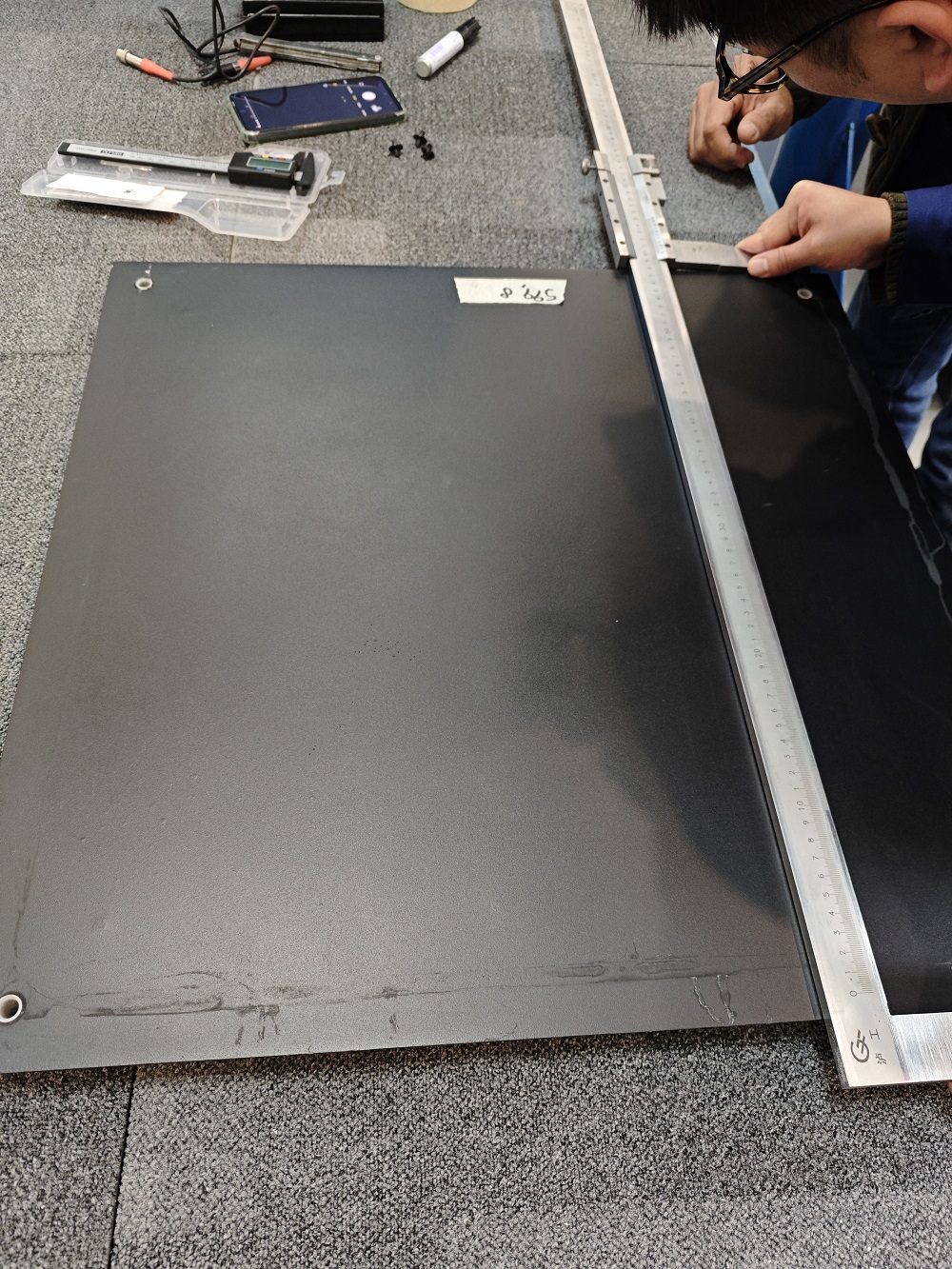
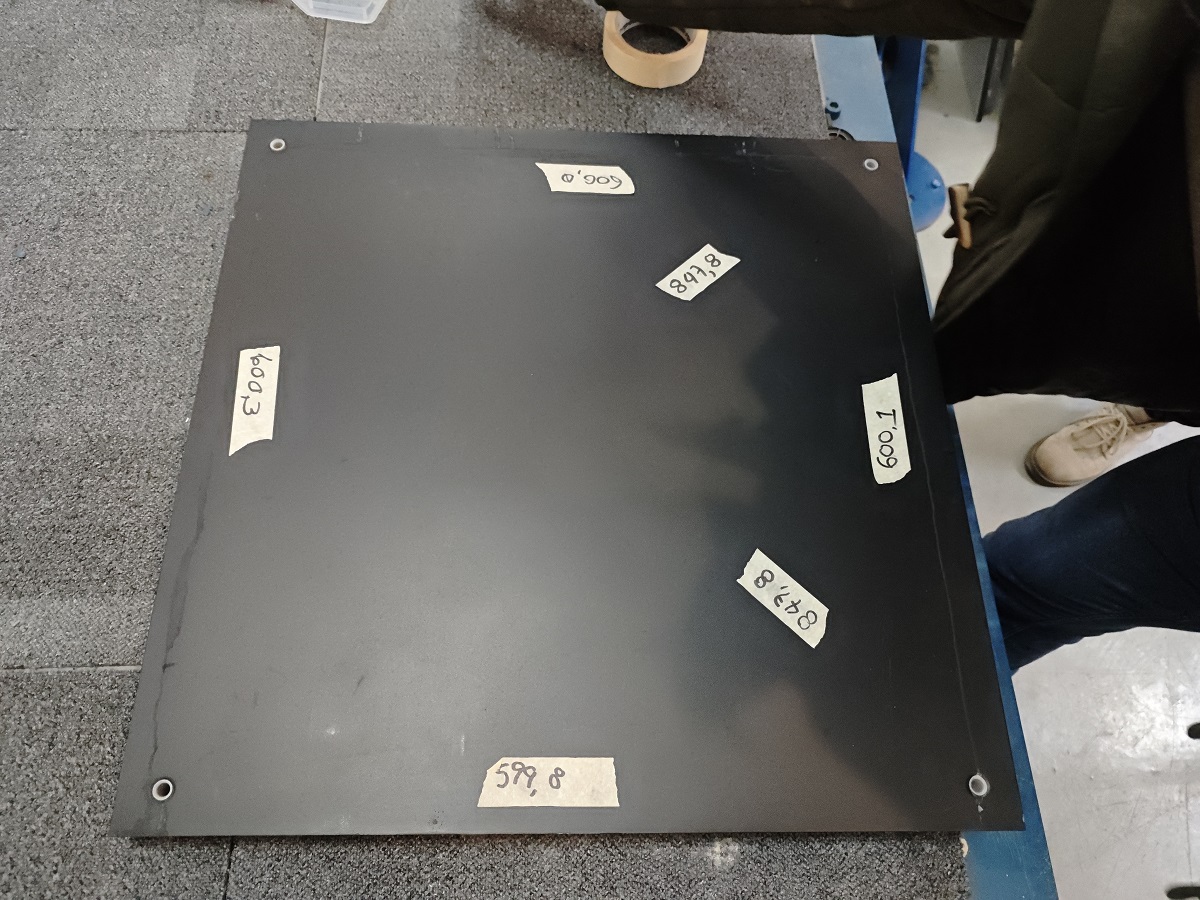
Panel edge length l (precision 0.5 mm; tolerance ±0.06% to ±0.5 mm)
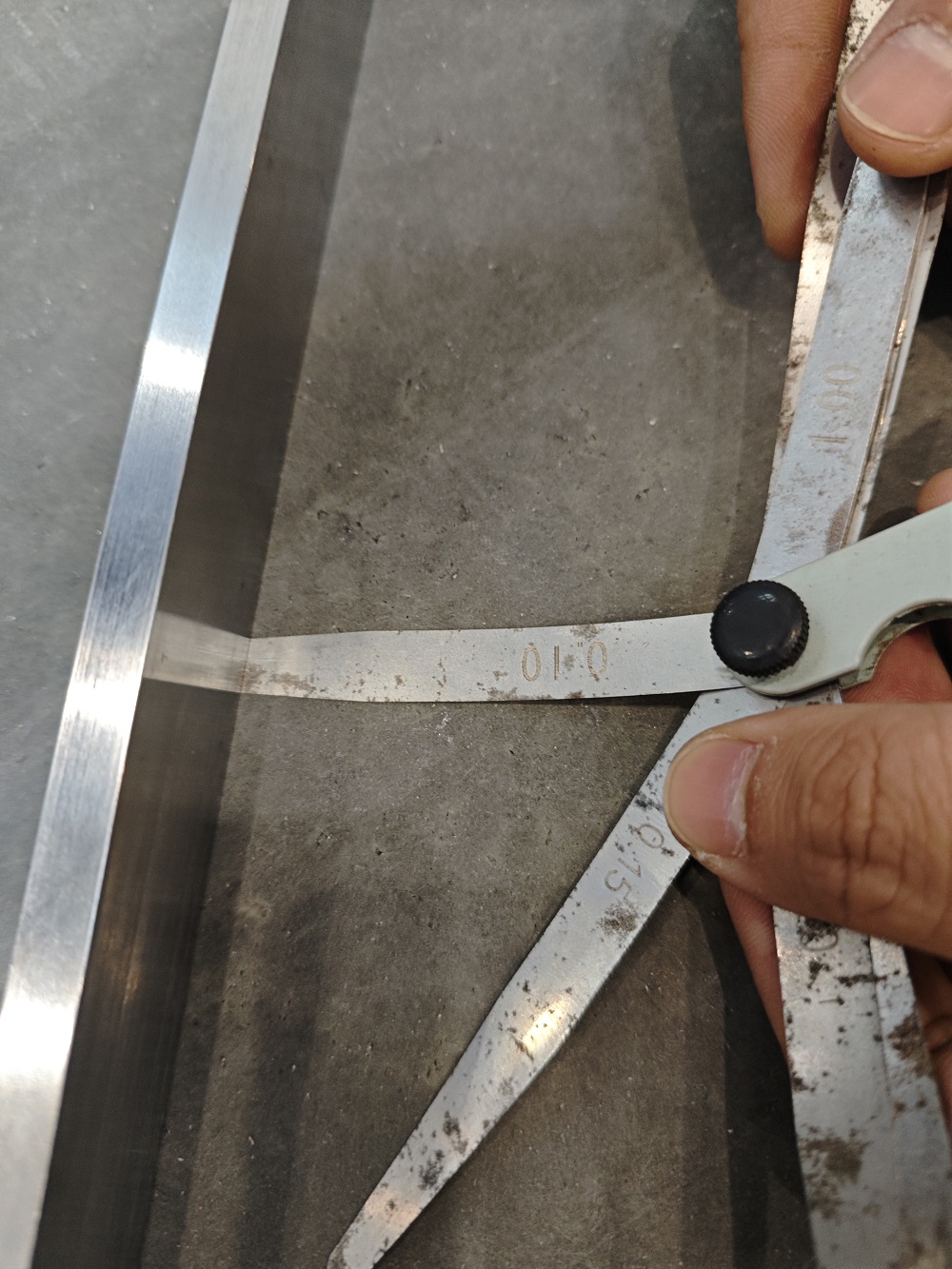
Equipped with a complete set of measuring tools, including 0.05 mm precision vernier calipers, flat crystal rulers, metal angle rulers, and gap gauges, five-point measurements are performed on the four sides, four corners, and diagonals of each Huiya HY-OA floor series panel such as SC (1000-3000) Steel Cementious Raised Access Floor, achieving 100% Grade I highest precision level and meeting the highest interchangeability requirements of the “integrated bonding of surface finishing materials” process.
This is a fundamental prerequisite for ensuring uniform gaps in raised floor panels and meeting the standards for precision environments such as computer rooms.
② Load-Bearing Test (Static Load)
Test Content: Using a Φ50 mm steel cylindrical pressing head with a ball seat to eliminate eccentric load, applying specified loads (2000 N / 3000 N / 4000 N / 5000 N) at a rate of 2000 N/min on the weakest part of the panel. Measurements include:
Deformation at the prescribed load (≤ 5.0 mm)
Residual deformation after unloading to 200 N (≤ 3.0 mm)
Procedure:
Preload zeroing: Hold 200 N for 1 min → zero the displacement gauge
Working load stage: Load to 1.5 / 2.0 / 3.0 kN (per floor grade), hold 1 min, record central deflection
Ultimate load stage: Continue pressing until failure (cracks/collapse/load drop)
Unload residual deformation: Unload uniformly to 200 N, hold 1 min, read residual deformation
Measurement positions: Center point + long edge midpoint + diagonal 1/4 point (3 mandatory points)
Criteria (JIS A 1450:2021):
Item
Criterion
Max deflection at working load
≤ 2.0 mm
Residual deformation
≤ 0.5 mm
Ultimate load
≥ 1.5× working load
Appearance
No cracks, no delamination, no peeling
JAFA Allowable Live Load Reference:
Specified Load
Allowable Live Load
Application Example
2000 N
1300 N
General office, light furniture
3000 N
2000 N
General bookshelves, office furniture
4000 N
2600 N
Heavy Duty Zone
5000 N
3300 N
Large mainframes, data centers
Huiya Equipment:
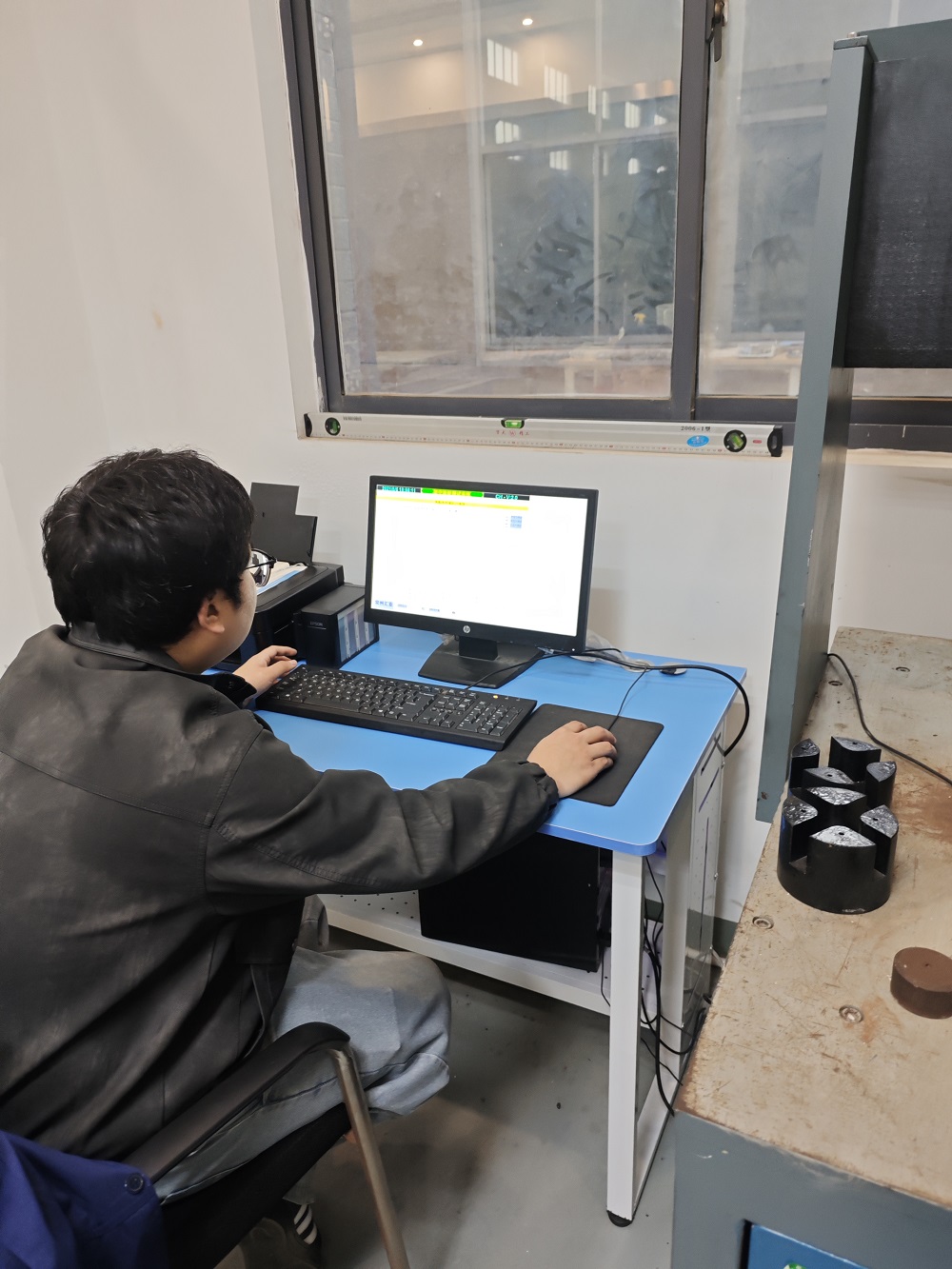
Equipped with a 2 m column-type universal testing machine (accuracy ±1%) and 0.1 mm digital displacement gauges, capable of synchronously measuring deflection and residual deformation. Huiya all-steel anti-static floor exhibits only 1.3 mm central deflection under 3000 N concentrated load and ≤ 0.2 mm residual deformation, exceeding JIS criteria across the board. Huiya products are tested at multiple grades (2000 N / 3000 N / 4000 N / 5000 N) to suit applications from general offices to large mainframe rooms.
Huiya’s flagship HY OA all-steel raised floor has a load-bearing capacity of 3000 N to 5000 N, and can be flexibly selected for different scenarios such as general offices, computer rooms, and data centers.
③ Impact Test
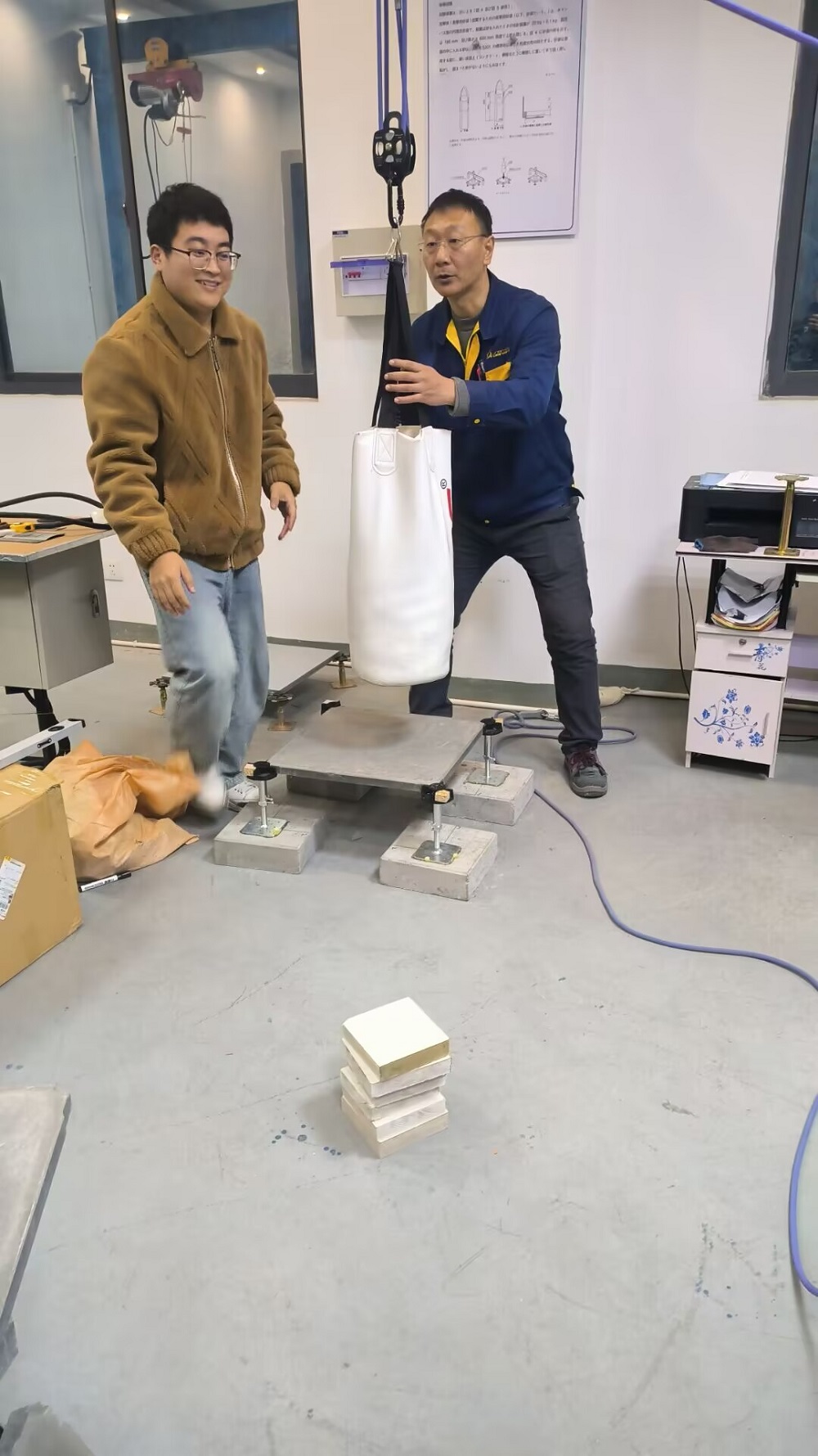
Test Content: A 30 kg standard sandbag (Φ220 mm × 700 mm height, filled with JIS R 5201 standard sand) is dropped freely from 250 mm above the panel surface to impact the weakest part. Deformation difference is measured before and after using a 20 kg hammer.
Key Parameters:
Dropping hammer: steel, 1 kg, R50 mm spherical bottom (some tests use 20 kg sandbags)
Drop height: 300 mm / 500 mm (per floor grade)
Specimens: 3 full panels, four-point support per actual installation
Criteria:
Item
Criterion
Indentation depth
≤ 1.0 mm
Appearance
No cracks, no delamination, no peeling
Specimens
All 3 panels must pass
Huiya Equipment:
A complete sandbag free-drop impact testing apparatus (with fixed pulley, lifting belt, gauge bracket) and precision displacement system reproduces the impact of a 30 kg ±0.1 kg sandbag, equivalent to a 20 kg copy paper bundle dropping from 700 mm height.
This test ensures Huiya floors will not crack or dent from accidental drops, protecting underfloor cables and equipment.
④ Rolling Load Test
Test Content: Using JIS B 8922-compliant industrial wheels to simulate office cart and IT equipment trolley repeated rolling, evaluating fatigue, wear resistance, and joint strength.
Key Parameters:
Trolley: 4 wheels, Φ75 mm diameter, 20 mm width, rubber hardness 70°
Total load: 1.0 kN (~100 kg)
Travel speed: 0.5 m/s
Cycles: 1,000 round trips (2,000 passes); some tests extend to 5,000
Criteria:
Item
Criterion
Joint level difference
≤ 0.5 mm
Appearance
No cracks, no obvious wear, no fracture
Pedestal/stringer
No looseness, no deformation
Specimens
All 3 panels must pass
Huiya Equipment:
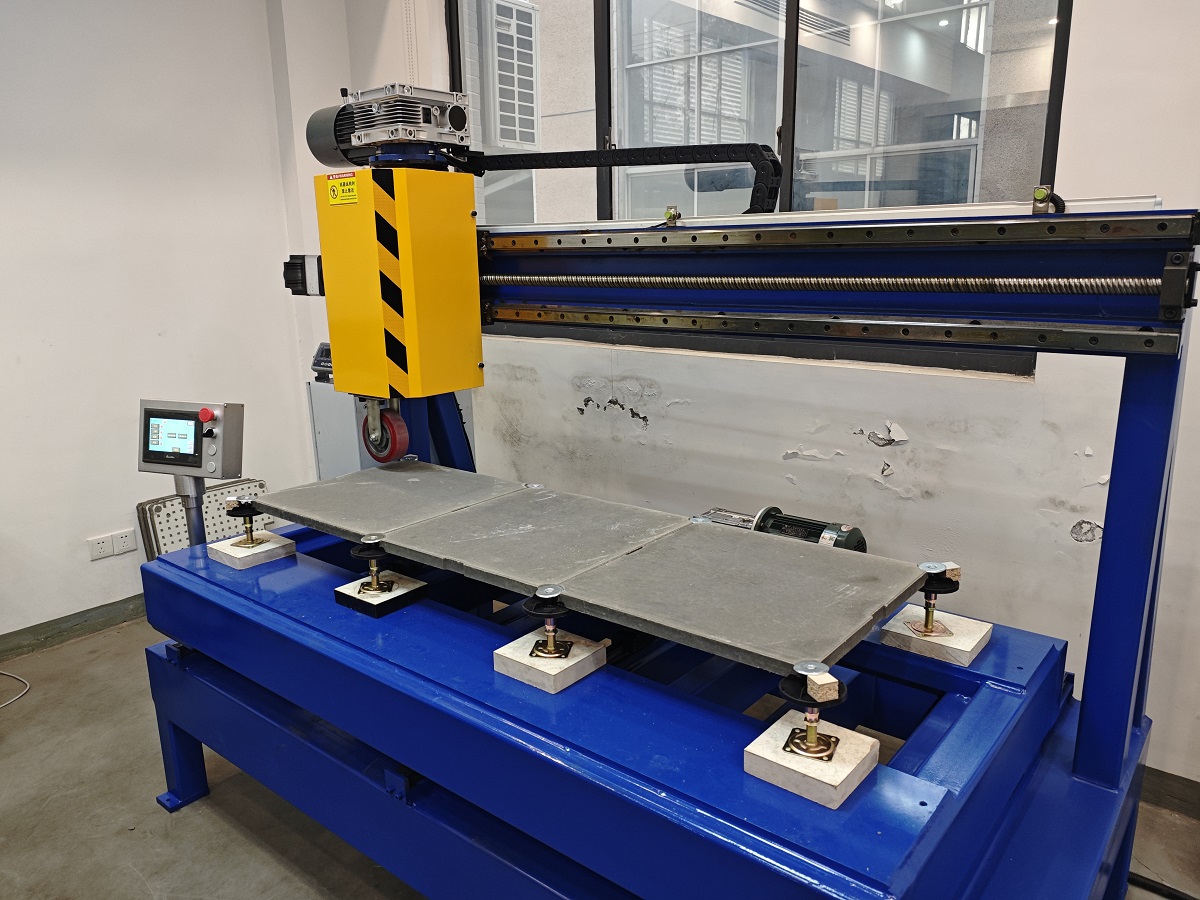
A custom rolling load durability tester with PLC touchscreen control + servo reciprocating mechanism simulates approximately 10 years of cart traffic on a 9-unit floor layout, validating the durability of Huiya’s aluminum locking structure.
This means Huiya floors can be reliably deployed in server rooms and offices with frequent equipment movement.
⑤ Combustion Test (Non-flammability)
Test Content: Simulates a small underfloor cable fire to evaluate flame retardancy, afterflame, smoldering, and dripping risks of the floor’s surface and substrate.
Distance: Fuel pan placed 50 mm directly below the panel center
Specimens: 3 full panels, horizontally raised, four-corner supported
Criteria (JIS A 1450:2021 mandatory):
Item
Criterion
Afterflame time
≤ 30 s
Smoldering time
≤ 60 s
Flame spread
Must not spread to edges
Surface damage
No obvious carbonization, blistering, delamination, peeling
Drips
No molten drips, or drips do not ignite combustibles
Specimens
All 3 panels must pass
Huiya Equipment:
Independent combustion test room with constant temperature/humidity (23±2°C, 50±5% RH), 0.1 s precision stopwatch, 0.1 cm³ precision fuel meter, and standard combustion box. Huiya’s all-steel anti-static floor cavity is filled with cement, making it intrinsically non-flammable with 0-second afterflame – far exceeding JIS A 1450:2021 requirements.
The Huiya all-steel anti-static floor body is press-welded from two cold-rolled steel sheets with cement-filled cavity, achieving Grade I non-combustibility, well above JAFA’s recommended Grade II.
⑥ Electrification Test (Static Voltage)
Test Content: Per JIS A 1455 “Anti-static performance of floor materials and floors—measurement and evaluation methods,” measures the maximum static voltage and half-decay time generated during walking. A grounded copper plate and rubber insulation plate are placed beneath the specimen to measure:
Maximum static potential V
Half-decay time (ms)
Calculate U value
Evaluation: General office U ≥ 0.6; computer room U ≥ 1.2
Strictly conditioned laboratory at 20°C±5°C, 30±10% RH, with JIS A 1455 standard electrification testing apparatus. Huiya HPL anti-static finish and ceramic anti-static finish series products keep human body charge voltage within 800 V, meeting requirements for highly sensitive sites such as computer rooms and semiconductor cleanrooms.
⑦ Resistance Test (Leakage Resistance)
Test Content: Measures surface resistance and ground resistance to ensure rapid static dissipation while preventing electric shock. A metal cylindrical electrode with diameter 60 mm ± 5 mm, mass 2.0 kg ± 0.3 kg is placed on the specimen, and after applying 500 V DC for 1 minute, the insulation resistance is read.
Key Parameters:
High-resistance meter: range 10⁴–10¹² Ω, accuracy ±10%
Electrodes: Φ50 mm copper, 5 N pressure, conductive rubber contact
Voltage: DC 500 V, hold 60 s
Criteria (Anti-static Grades):
Item
Range
Surface resistance
1×10⁶ – 1×10⁹ Ω
Ground resistance
1×10⁵ – 1×10⁸ Ω
Huiya Equipment:
Equipped with a 500 V high-precision insulation resistance meter (±10% accuracy, 1 MΩ measurement range) to verify vertical impedance from the floor to the grounding electrode, preventing electric shock from contact leakage.
The Huiya anti-static floor’s HPL surface and base steel sheet form a stable resistance path, complying with the triple safety standards of IEC, JIS, and GB/T.
⑧ Vibration Test (Seismic Resistance)
Test Content: Simulates earthquake acceleration and equipment vibration to evaluate resonance, panel detachment, joint loosening, and structural damage. For office floors with unit height ≤ 200 mm, a vibration table ≥ 1000 mm × 2500 mm is loaded with prescribed weights (150 / 200 / 350 kg) and excited with sine-wave-based input. Prescribed accelerations:
600 cm/s² (low-rise buildings, floors 1–4)
1000 cm/s² (mid-rise buildings, floors 5–10)
The key evaluation focus is whether panels detach after the earthquake, plus damage, gaps, and horizontal displacement as evacuation safety indicators.
Criteria:
Item
Criterion
Amplitude amplification
<2×, no obvious resonance
Resonant frequency
>20 Hz (avoiding human-sensitive range)
Structural status
No looseness, no abnormal noise, no shaking
Panels
No detachment, no horizontal shift, no lifting
Huiya Equipment:
A 2.5 m × 1 m large horizontal vibration test platform (electric servo type) reproduces realistic floor vibration scenarios for low- to mid-rise buildings under horizontal seismic waves, validating the integrity of Huiya’s screw pedestal + locking buckle structure during earthquakes.
This test ensures occupants can safely evacuate across the floor surface after an earthquake—one of the most critical safety indicators in the Japanese market.
III. Full JIS A 1450:2021 Test Checklist vs. Huiya Achievement
No.
Performance Item
JIS A 1450:2021 Criterion
Huiya HY-OA Series Measured
Pass
1
Dimension
Side ±0.06%, flatness ≤1.0 mm
Grade I throughout
✅
2
Static load
Deflection ≤2.0 mm, residual ≤0.5 mm
1.3 / 0.2 mm
✅
3
Impact
Indentation ≤1.0 mm, no cracks
≤0.5 mm
✅
4
Rolling load
Joint difference ≤0.5 mm
≤0.3 mm
✅
5
Combustion
Afterflame ≤30 s
0 s
✅
6
Electrification
Body charge ≤1000 V
≤800 V
✅
7
Leakage resistance
10⁶–10⁹ Ω
5×10⁶ Ω
✅
8
Vibration
No detachment, resonance >20 Hz
Fully compliant
✅
IV. Test Environment and Conditioning (Standard Requirements)
Huiya’s laboratory operates strictly per JIS A 1450:2021 environmental conditions:
V. Returning Japan’s Latest Quality Standards to Global Customers
Japan’s OA floor market sets globally leading product quality requirements. JIS A 1450 not only stipulates detailed test methods but is supported by JAFA’s strict performance evaluation system. By aligning early with the latest JIS A 1450:2021, Huiya has elevated itself from a top domestic OA anti-static floor supplier to an internationalized manufacturer capable of full self-validation for premium markets including Japan, Southeast Asia, and Europe.
“A single floor panel may seem ordinary, yet it carries the stable operation of data centers, the safety of office occupants, and the last line of evacuation defense when earthquakes strike. Huiya takes JIS A 1450:2021 as the highest testing benchmark, perfecting every critical metric.”
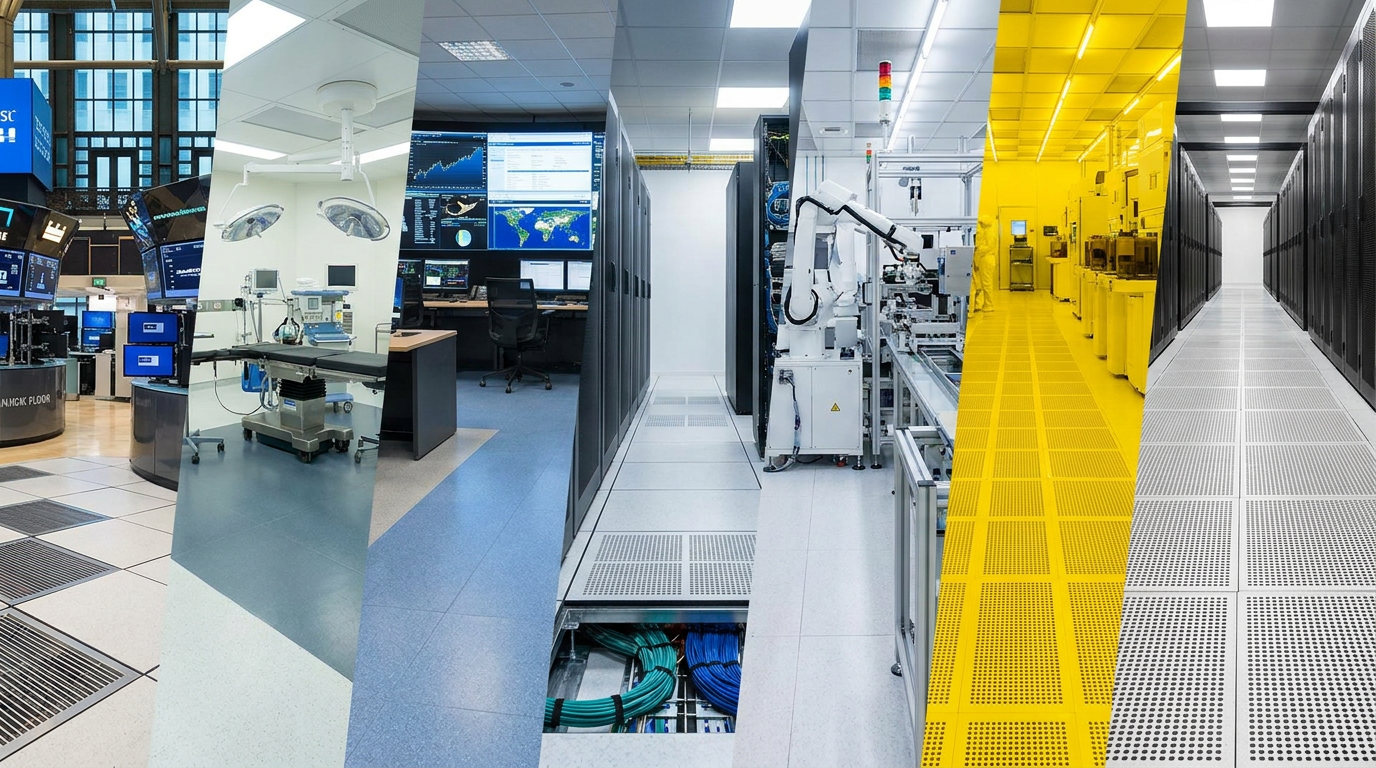
Huiya raised access floor products span calcium sulfate, all-steel, aluminum alloy, and other substrates, suitable for general offices, data centers, and computer rooms. Through a comprehensive JIS test system, Huiya rigorously controls every performance metric before factory shipment, ensuring every panel delivered to Japanese customers meets JIS standards.
? Website:www.huiyainc.com ? Hotline: Call to request the full JIS A 1450:2021 test report ? Business Inquiries: Welcome inquiries on OA floor projects for Japan and Southeast Asia