

An elevated floor rarely fails because of the tiles on top. It fails because of what is underneath. Here is a specifier’s guide to the support system and the two purpose-built PP pedestals that cover every common build-up.
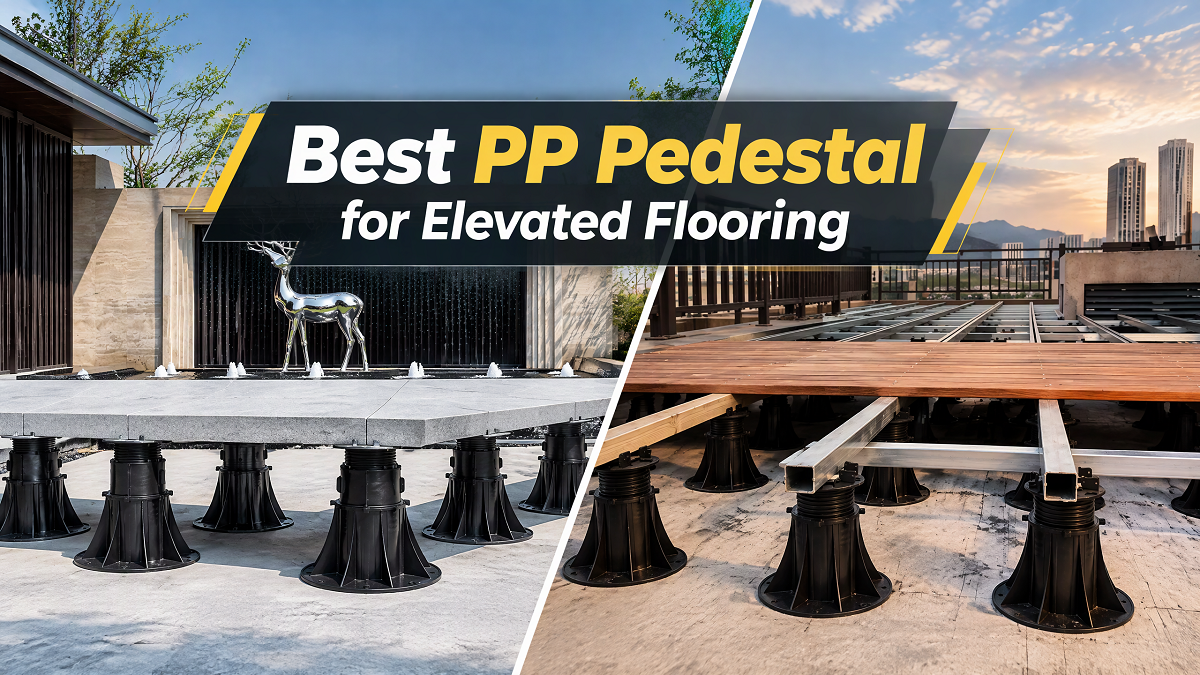
Best PP Pedestal for Elevated Flooring: How to Choose the Right Support System
An elevated floor rarely fails because of the tiles on top. It fails because of what is underneath: a support system that cannot hold the load, cannot be levelled, cannot drain, or cannot be adjusted once the substrate moves. Choosing the best PP pedestal for elevated flooring is therefore not a price comparison between plastic parts. It is a specification decision about the entire support system.
Here we are going to explain what an elevated flooring support system actually has to do, and how to choose the best polypropylene (PP) pedestals on the market for stable support. Then we will recommend two PP pedestals supplied through HUIYA’s partnership with Trumshi: the CX/CXM Series pedestal for joist and the CXL Series pedestal for tile, and explain why they are the best-fit choice for the two main elevated flooring build-ups.
1. What Does an Elevated Floor Need from Its Support System?
Every elevated floor follows the same principle: finished surface panels are raised above the structural slab on height-adjustable pedestals, creating a void between the two. That void is the reason the floor exists.
- Indoor raised access flooring (data centres, offices, cleanrooms) uses steel pedestals, stringers and 600 × 600 mm panels. The void carries power cables, low-voltage wiring, fibre optics, HVAC air and pipework, and any panel can be lifted for access.
- Outdoor elevated paving and decking (rooftop terraces, podium decks, pool surrounds, plazas, balconies) uses PP adjustable deck supports. The void drains rainwater, ventilates the waterproofing membrane, conceals irrigation and lighting cables, and lets individual pavers or boards be lifted for maintenance.
The environments differ: indoor systems are specified against CISCA 2007, EN 12825:2001, KS F 4760 or JIS A 1450:2005, while outdoor systems are judged on weather exposure, drainage and membrane protection, but the engineering logic is identical: the pedestal is the structural link between the load above and the substrate below. That is exactly why a raised access floor manufacturer such as HUIYA and an outdoor pedestal specialist such as Trumshi belong in the same supply chain.
What Does the Elevated Flooring Support System Do?
A pedestal is doing five things at once. If any one of them is weak, the finished floor will show it.
| Job | What it means on site | Failure mode when ignored |
|---|---|---|
| Load transfer | Carry the dead load of the surface plus live loads: foot traffic, furniture, planters, maintenance equipment, down to the slab without creep or crushing | Cracked pavers, deflection, sinking corners |
| Precision levelling | Compensate for an uneven or sloped substrate to millimetre accuracy, then lock the height | Rocking tiles, lipped joints, trip hazards |
| Drainage and ventilation | Keep an open void beneath the surface so water runs to outlets and the membrane can dry | Ponding, freeze–thaw damage, algae, membrane deterioration |
| Service access | Leave pipes, cables, drains and lighting reachable without breaking the surface | Destructive, costly maintenance |
| Substrate protection | Spread the point load over a wide base without drilling, bonding or wet trades | Punctured waterproof membranes, non-reversible installation |
Anatomy of an Adjustable PP Pedestal
Most professional pedestals are a modular assembly of five or six parts. Knowing them makes specifications far easier to compare.
- Base plate – a wide, ribbed circular flange that spreads load over the substrate. Ribbed undersides stop slipping and let water drain beneath the pedestal.
- Threaded middle column / extension tube – rotating it raises or lowers the head continuously; extension columns can be stacked to build greater void depths.
- Locking rings (fixing collars) – one at the base-to-column joint and one at the column-to-head joint. They lock the assembly at its set height and stop vibration from unwinding the thread.
- Head / top cap – the interface with the finished surface. This single component decides what the system can carry.
- Spacer tabs, shims and slope correctors – thin inserts that set consistent joint widths, provide micro height correction, or compensate for a drainage fall.
2. What is the PP Pedestal for Elevated Flooring?
“Best” is not a superlative; it is a fit between measurable product properties and project conditions. Use these eight criteria as a scorecard when comparing quotations.
- Verified compressive capacity at the installed heightDo not buy on a headline “2 tonnes” figure alone. Load capacity typically decreases as the pedestal is extended, and the relevant number is the rating at your finished floor height, with your pedestal spacing and your design load. Ask for test data, a project-specific layout and a load calculation, not a marketing number.
- Continuous, millimetre-accurate height adjustment with a positive lockA threaded column gives infinite adjustment within its band, rather than fixed shim increments. Insist on locking rings that prevent unintended rotation under dynamic foot traffic and thermal cycling.
- Slope compensation of at least 0–5 %Rooftops and podium decks are deliberately built with a fall to drains. A good system lets you create a perfectly level finished surface over a sloped substrate, or preserve a controlled fall, via slope-correcting heads, half-shims or similar accessories.
- The right head, with documented compatibilityFor joists, check cradle slot size and the range of joist widths accepted. For tiles, check the available spacer tab thicknesses, the supported slab formats and the laying patterns. A head that only fits one board or one tile size becomes a procurement problem later.
- A wide base that protects the membraneA broad, ribbed footprint spreads point loads over waterproofing membranes without puncturing them. The whole installation should be dry: no grout, no drilling, no wet trades, no mechanical fixing to the substrate.
- A genuinely outdoor-grade PP formulationLook for explicit UV resistance, freeze–thaw resistance, a stated operating temperature range, moisture/mould resistance, impact resistance and recyclability. These are the properties that determine whether the floor still performs after ten winters.
- Modular scalability and a complete accessory familyExtension columns, couplers, joist cradles, spacer tabs in several thicknesses, micro-adjustment shims, anti-slip pads and wind-uplift clips let one platform cover low balconies and 1.6 m-deep utility voids alike. Fewer unique SKUs mean simpler warehousing and faster installation.
- A supplier who can engineer, not just shipLayout planning, quantity take-offs, load calculations, QC inspection before shipment, export documentation and container loading are part of the product on a global project. The best pedestal in the world is a poor choice if nobody can tell you how many units per square metre your layout needs.
Choosing on unit price alone; comparing maximum load ratings without reference to height; and forgetting pedestal density, which drives both cost and long-term deflection.
One Decision That Matters Most: Joist Head or Tile Head
There are two fundamentally different head architectures, and they are not interchangeable in practice.
- A joist cradle head has a U-shaped slot that receives a linear bearer: timber, WPC or aluminium joist. Decking boards are then fastened to the joist grid. This is a frame-based build-up: rigid, good for long spans, ideal for timber and composite decking and for large-format tiles on a metal sub-frame.
- A flat tile/paver head supports the corners of individual slabs directly. Snap-off spacer tabs create uniform joints and hold the tiles apart; the pavers sit at the intersection points of the grid. This is a unit-based build-up: fast, fully reversible, ideal for porcelain, granite and natural stone.
Specifying the wrong head is the most common and most expensive mistake in elevated flooring. Decide the surface material first, then the head, then everything else.
Why Polypropylene Became the Default Material of Elevated Flooring Pedestals
Steel corrodes, concrete is heavy and permanent, timber rots, and mortar beds add 80–150 kg/m² of dead load while locking the surface in place. UV-stabilised PP avoids most of those problems in one injection-moulded part:
- Waterproof and corrosion-resistant – unaffected by rain, standing water, irrigation, road salts, bitumen and coastal air.
- Weather-stable – quality PP formulations resist UV degradation, ageing and freeze–thaw cycling across a wide service temperature range.
- Light but strong – a pedestal weighing a few hundred grams can carry tonnes in compression, keeping rooftop and podium imposed loads low.
- Chemically inert and mould-resistant – no rot, no alkali efflorescence on natural stone.
- Fully recyclable – dry installation means no mortar waste, no curing water and a reversible, recoverable build-up.
One specification tip: ask for the actual resin grade and UV-stabiliser package in writing. Product literature sometimes uses “HDPE” loosely for polyolefin pedestals, but HDPE is polyethylene, not polypropylene. Recycled content, glass-fibre reinforcement and additive packages vary widely between suppliers, and they directly affect long-term compressive creep and brittleness in cold climates.
3. Best PP Pedestal for Elevated Flooring Recommend: Trumshi CX and CXL
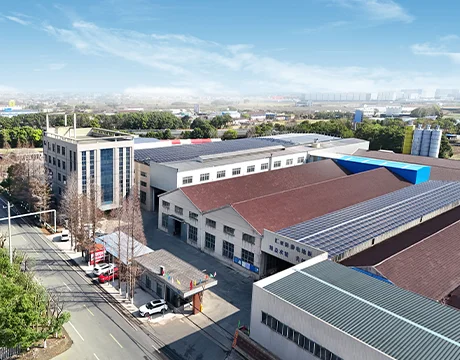
HUIYA (Changzhou Huiya Decorative Materials Co., Ltd., founded 2005) manufactures raised access floor systems for offices, data centres and cleanrooms to Chinese national standards plus CISCA 2007, EN 12825:2001, KS F 4760 and JIS A 1450:2005. Trumshi (创象, Zhejiang Trumshi New Materials Co., Ltd., Hangzhou, founded 2018) is one of China’s earliest specialist manufacturers of adjustable deck supports, with a Hangzhou R&D centre, a 5,000 m² factory, 15 production lines and exports to Europe, the Americas and Australia.
The two companies are strategic partners for a straightforward reason: HUIYA covers indoor raised floors, Trumshi covers outdoor and landscape elevated surfaces, and both are built on the same raised-on-pedestals principle. Ordering through HUIYA means one-stop supply of indoor raised floor panels and outdoor pedestals in a single order, QC inspection before shipment, engineering support for layout and load calculations, factory-direct pricing, export-experienced global logistics, and after-sales follow-up. For a specifier, that turns eight separate procurement decisions into one accountable supplier relationship.
PP Pedestal for Joist – Trumshi CX/CXM Series Adjustable Deck Support
View the CX/CXM Series product page →
The CX Series is purpose-built around a joist cradle head with a 50 × 60 mm slot that locks timber or aluminium joists into a level structural grid. It accepts joist widths of 30, 40, 50 and 60 mm, covering standard timber battens and aluminium profiles. Decking boards, solid timber, WPC, aluminium composite, are then fastened to the joists, giving excellent rigidity and clean separation between the finished deck and the waterproofed substrate.
Key published figures: high-strength PP; UV and freeze–thaw resistance; impact and load resistance over 2.5 tonnes per pedestal; operating temperature –30 °C to +120 °C; slope adjustment 0–5 %; dry installation with no adhesives or wet trades. The low-profile CX00 range spans 10–117 mm across twelve model variants, while the modular CX/CXM platform reaches greater heights with additional extension columns; HUIYA’s technical team should confirm the exact band for each configuration before specification.
Typical applications: rooftop terraces and sky gardens over sloped waterproof membranes, timber and composite decks, balcony renovations, hotel and commercial plaza decks, landscape boardwalks, and indoor/outdoor raised floors needing underfloor cable management or ventilation. As a quantity guide, HUIYA lists roughly 12 sets/m² for 300 × 300 mm grids, 7 for 400 × 400 mm, 5 for 500 × 500 mm, 3 for 600 × 600 mm and 2 for 800 × 800 mm; joist-based systems commonly fall in the 4–6 pedestals/m² range depending on joist spacing and design load.
Best PP Pedestal for Tile – Trumshi CXL Series Adjustable Deck Support
View the CXL Series product page →
Where CX supports a frame, CXL supports the slab itself. A flat head with functional spacer tabs holds each tile or stone slab at its corners, creating uniform joints and even load distribution. Tabs come in 2, 3, 5, 8 and 10 mm thicknesses and their arms snap off to suit cross-joints, edges, T-joints and single corners. Split half-moon functional shims deliver 2 mm micro-correction on one side of the head for fine slope adjustment, while a 0–5 % slope correction range handles drainage falls. Two black locking rings — at the base and at the head, lock the assembly at its final height.
Key published figures: PP, UV/ageing and corrosion resistant, recyclable; 37–1,600 mm height range via stacked extension columns; 1.5–2 tonnes per pedestal standard and 2–3 tonnes heavy duty; –30 °C to +120 °C; 95 mm base and 95 mm column; compatible with slab formats from 500 × 500 mm to 1200 × 600 mm, in cross-joint and running-bond patterns; suitable for concrete slabs, waterproofing membranes, existing tile and compacted aggregate.
The practical gains over a traditional mortar bed are substantial: no cement contact means no alkali efflorescence on natural stone; the open joints and continuous void drain freely; a mortar build-up typically adding 80–150 kg/m² is replaced by pedestals weighing roughly 0.3–0.8 kg each; and any single tile can be lifted to service pipes, cables, lighting or the membrane, then replaced, even with height re-adjustment after settlement. Applications include commercial plazas, rooftop gardens and podium terraces, hotel and resort outdoor spaces, residential balconies, fountain and pool surrounds, and landscape pathways.
FAQs For Choosing the PP Pedestals for Elevated Flooring
What is a PP pedestal and why is polypropylene used for elevated flooring?
A PP pedestal is a height-adjustable polypropylene support that raises decking, tiles or stone above the structural slab. PP is waterproof, corrosion-resistant, UV-stable, lightweight, recyclable and strong in compression, making it better suited than steel, timber or mortar beds for exposed outdoor substrates and waterproofing membranes.
What is the difference between a pedestal for joist and a pedestal for tile?
A joist pedestal (Trumshi CX/CXM) has a cradle that holds timber or aluminium joists; decking boards are fixed to that grid. A tile pedestal (Trumshi CXL) has a flat head with spacer tabs that support the corners of individual slabs directly, creating consistent joints. Choose by surface material first.
Can PP pedestals be installed over a waterproofing membrane?
Yes. The wide base distributes load without puncturing or bonding to the membrane, and the system is fully dry-installed with no grout, drilling or wet trades. Where mechanical fixing is not permitted but bonding is required, a compatible pedestal adhesive can be specified, consult the project engineer.
How many pedestals do I need per square metre?
It depends on slab size, joist spacing and design load. HUIYA’s guidance ranges from about 12 sets/m² for 300 × 300 mm grids down to 2 sets/m² for 800 × 800 mm; joist-based systems commonly use 4–6 pedestals/m². Always request a project-specific layout calculation.
Can the floor be re-levelled after installation?
Yes for dry-lay systems. Individual tiles are lifted, the threaded column is rotated to the new height, the locking rings are re-tightened and the tiles are replaced — useful after settlement or underfloor utility work.
Are PP pedestals suitable for cold and coastal climates?
Quality UV-stabilised PP is rated for freeze–thaw cycling and, for the Trumshi CX and CXL series, an operating range of –30 °C to +120 °C, with resistance to moisture, mould and chemical exposure. Confirm the resin grade and additive package with your supplier.
Huiya Real-Time News
Huiya Real-Time News is dedicated to providing you with the latest and most authoritative information on the raised flooring industry.
We provide 24/7 updates on industry policy interpretations, market trend analysis, company news.
Liquid Cooling Data Center Flooring Solutions

MORE DOWNLOADS

GENERAL CATALOGUE
HUIYA INTRODUCTION

HUIYA GREEN LABEL
CAD/BIM FULL STEEL
APPLICATION SCENARIOS


