

Almost every watt of electricity a server room draws ends up as heat. That heat can become a serious problem very quickly, which is why precision cooling sits at the heart of every data center, server room, and computer room. Today, we are going to explain what a server room cooling system actually does, the main types used in modern facilities, and how CRAC, CRAH, and AHU systems compare when planning an HVAC design, to give you a good understand on cooling solution that fits different facility sizes, workloads, and reliability goals.
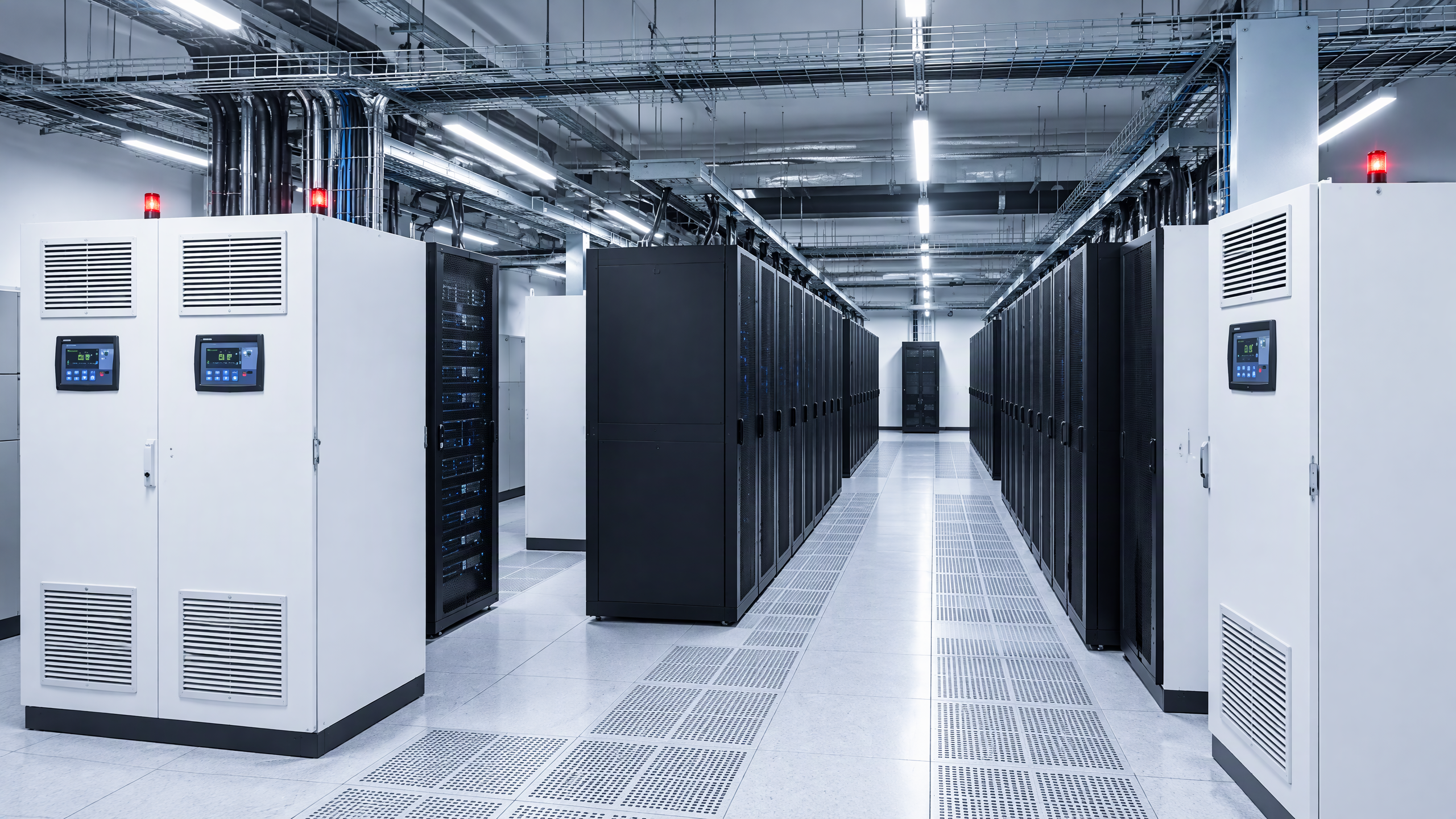
What is a Server Room Cooling System?
A server room cooling system is a precision HVAC setup built to remove heat continuously from spaces filled with IT equipment. Unlike a normal office air conditioner that focuses on human comfort, a server room cooling system protects hardware and maintains stable operating conditions every second of the day.
Servers are designed to operate within a certain temperature range. If the environment becomes too hot, performance can drop, hardware can become unstable, and equipment may shut itself down to protect its components. Cooling is not just about making the room comfortable. It is part of keeping the facility available.
A server room cooling system handles more than temperature. It also manages airflow direction, humidity levels, heat removal paths, redundancy, and continuous environmental stability. Industry guidance typically recommends server inlet air somewhere around 18°C to 27°C. Servers don’t need icy air, but they do need steady conditions, free of large swings in temperature or humidity.
Why Server Rooms Need Precision Cooling
Unlike a normal office building, data centers cannot tolerate unstable temperatures. Servers generate enormous amounts of heat continuously, and unlike people, servers never go home at night. They operate 24 hours a day, 365 days a year.
Even a small temperature rise can create problems including thermal throttling, equipment shutdowns, reduced hardware lifespan, or complete system failures. A single server rack can produce anywhere from 17,000 to over 102,000 BTU every hour. Multiply that by hundreds or thousands of racks, and you have an environment that demands dedicated cooling equipment running around the clock.
Different Types of Server Room Cooling Systems
Several cooling systems are used across modern IT environments. Each one works a little differently, and each fits specific types of rooms and loads.
CRAC Units (Computer Room Air Conditioner)
A CRAC unit is a self-contained cooling system with its own refrigeration cycle built in. It works very similarly to a traditional direct expansion air conditioning system, often called a DX system by HVAC technicians.
What it is: A CRAC is a specialized air conditioner dedicated to IT environments. Inside the unit sits a full refrigeration circuit containing a compressor, refrigerant, expansion valves, an evaporator coil, and a condenser system.
How it works: Fans draw warm return air from the room across a cold evaporator coil. Refrigerant inside the coil boils, absorbing the heat, and the cooled air is pushed back out to the servers, usually up through a raised floor and into the cold aisle. The compressor then squeezes that heat-laden refrigerant into a hot, high-pressure gas and sends it to a condenser, which rejects the heat to the outside, either to air, water, or glycol.
Some CRAC units can also be ordered with dual cooling coils. For example, a unit may have a DX refrigeration coil as the primary cooling source and a chilled water coil as a secondary or backup source. A CRAC unit may also help control humidity, which matters because data centers need much more precise environmental control than a normal office.
CRAH Units (Computer Room Air Handler)
A CRAH looks similar to a CRAC from the outside, but the way it removes heat is very different.
What it is: A CRAH unit does not contain compressors or refrigeration equipment. Instead, it relies on chilled water supplied from a central chiller plant. Inside the CRAH is a chilled water coil, large fans, filters, humidification systems, and controls.
How it works: The CRAH pulls warm return air from the data center. That air passes across a chilled-water cooling coil. The cold water inside the coil absorbs the heat, and the cooled air returns to the data center. A control valve modulates the water flow to hold the air temperature steady.
The warmed water travels back to the central chiller plant, where the chiller removes the heat again. That heat is eventually rejected outside through equipment such as cooling towers or dry coolers. So the refrigeration cycle hasn’t disappeared in a CRAH system. It has simply moved out of the room and into the chillers, where one big plant can serve dozens of CRAHs at once.
AHU (Air Handling Unit)
An Air Handling Unit is a broader term used across many building HVAC designs, including server rooms that use underfloor air distribution (UFAD).
What it is: An AHU is a general-purpose unit that conditions and moves air throughout a space. In a UFAD setup, conditioned supply air is delivered to the underfloor plenum by an AHU or a central HVAC system.
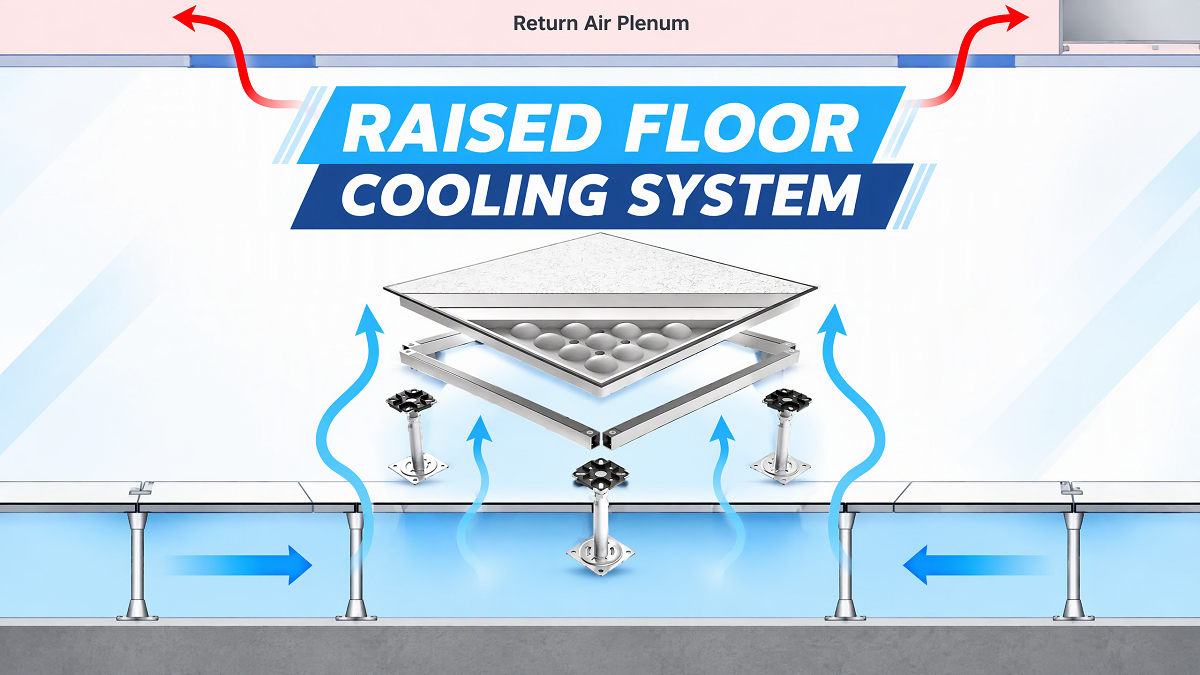
How it works: The AHU pushes conditioned air into the raised floor plenum through a network of supply ducts beneath the floor. These ducts are designed to evenly distribute air across the floor area. In the occupied space, specially designed swirl diffusers are installed on top of the raised floor. The conditioned air flows upward through the floor grilles and enters the occupied space as an upward draft. Once it has provided cooling or heating, the air rises and is extracted through return grilles located in the ceiling, then directed back to the AHU for reconditioning.
AHUs are flexible units that can be paired with chilled water coils, DX cooling coils, outside air economizers, or combinations of all three. They are common in office buildings, mixed-use data facilities, and server rooms where underfloor air distribution is used.
In-Row Cooling Units
Instead of placing cooling units around the room perimeter, in-row systems are installed directly between server racks, much closer to the actual heat source. They pull hot air from the hot aisle, cool it immediately, then push cold air back into the cold aisle. Because airflow paths are shorter, cooling becomes more efficient while fan energy usage drops.
Rear-Door Heat Exchangers
A liquid-cooled heat exchanger is installed at the back of the rack. As hot air exits the servers, liquid-cooled coils absorb the heat almost instantly. This design works well for medium to high-density racks where room-based cooling cannot keep up.
Direct-to-Chip and Immersion Liquid Cooling
As servers become more powerful, air cooling becomes more difficult. This is especially true for high-density GPU and AI systems. Liquid can move heat much more effectively than air. In direct-to-chip cooling, a cold plate is installed directly on top of components such as the CPU or GPU. Coolant flows through the plate and absorbs the heat. In immersion cooling, entire servers may be placed into a special non-conductive liquid.
CRAC vs CRAH vs AHU, Which is the Best for HVAC
At first glance, CRAC, CRAH, and AHU systems can look almost identical from the outside. Large cabinets, massive fans, raised floor connections, supply air and return air pathways. But internally, they operate in completely different ways, and each has strengths that fit specific situations.
Difference: Where the Refrigeration Happens
The simplest way to compare these systems is to ask one question: where does the actual cooling take place?
- A CRAC unit contains refrigeration equipment inside the room.
- A CRAH unit uses chilled water from a central plant.
- An AHU is a flexible platform that can use chilled water, DX coils, or outside air depending on the design.
That single question of where the refrigeration happens shapes the piping, the power backup, the failure modes, and the running costs of the entire cooling system.
Efficiency Comparison
One large chiller plant is usually more efficient than dozens of small compressors. It can use free cooling when the outdoor air is cold enough, and there are fewer mechanical parts sitting next to your servers. This is why CRAH-based chilled water designs dominate larger data centers.
AHUs paired with chilled water or outside air economizers also perform well in large commercial buildings, where the ability to mix return air with outside air lowers mechanical cooling demand. CRAC units are generally less efficient at scale, but they are self-contained and simpler to deploy.
Electrical and Redundancy Differences
There’s an electrical difference that matters to anyone designing the power side. A compressor draws a large starting current, and after a power loss, it typically waits several minutes before restarting to protect itself from short cycling. So even after the generators pick up the load, a CRAC can leave the room without cooling for a while.
CRAH fans, by contrast, restart almost immediately, and the chilled water in the pipework and buffer tanks can keep absorbing heat for minutes. That’s why designs often put CRAH fans and chilled water pumps on UPS support, so cooling keeps flowing through the gap.
On the redundancy side, chilled water plants carry a single point of dependency. If the chillers or pumps fail, every CRAH in the hall loses its cooling at once. A failed CRAC only takes out that one unit. That’s why chilled water designs invest so heavily in redundant chillers, pumps, and dual pipework loops.
Scalability and Infrastructure
CRACs are self-contained, so you don’t need a chiller plant or a network of chilled water pipework. That makes them a natural fit for small server rooms, edge sites, and phased builds where you add cooling capacity one unit at a time.
CRAH units depend on chilled water infrastructure. They need a central chiller plant, pumps, pipework, and buffer tanks. The upfront cost is higher, but the system scales more efficiently as facility size grows.
AHUs are often used in mixed buildings where the same equipment handles office zones, mechanical rooms, and server areas. They are easy to zone, flexible with coil choices, and well suited to underfloor air distribution.
Which One Wins?
There is no single winner. The right choice depends on scale, efficiency targets, and how much redundancy you can build around it. For a small site, the simpler CRAC can be the more sensible and even the more reliable option. For a hyperscale facility running thousands of racks, CRAH systems backed by a central chilled water plant deliver better efficiency and more flexibility. For buildings that combine office spaces with server rooms, AHUs with mixed cooling sources often fit best.
Best Server Room Cooling System For Different Facilities & Purposes
Choosing the right cooling system depends on the type of facility, the heat load per rack, and the operating strategy.
Small Server Rooms and Edge Sites
For small server rooms, edge data centers, and phased installations, CRAC units are usually the best fit. They are self-contained, do not require a chiller plant, and can be added one unit at a time as the room grows. Maintenance is simpler because each unit is independent, and a single failure only affects that one unit.
CRAC units also work well in retail locations, bank branches, small offices, and remote telecom sites where chilled water infrastructure would be impractical.
Medium-Sized Enterprise Data Centers
Enterprise data centers often use a mix of CRAC and CRAH systems. CRAH units handle the main cooling load for the primary data hall, backed by a central chiller plant. CRAC units may serve smaller rooms, telecom spaces, or offer backup redundancy where chilled water is not available. Hot-aisle or cold-aisle containment is typically added to reduce air mixing and improve efficiency.
Large and Hyperscale Data Centers
For large data centers and hyperscale facilities, CRAH systems backed by central chilled water plants dominate. One large chiller plant can serve dozens of CRAHs at once, and modern designs raise the chilled water temperature to give the chillers more free cooling hours, cutting energy use further.
At the largest sites, rows of CRAHs give way to fan walls, and as rack densities climb, more sites are moving water closer to the chip with liquid cooling.
AI and High-Density Computing Facilities
AI is changing data center cooling rapidly. Modern GPU clusters can generate extremely high heat loads, much higher than traditional server environments. Chilled water systems and CRAH-based designs have become increasingly popular in these facilities because water can transport heat much more efficiently than air.
Even CRAH systems are now reaching limits in some AI facilities. That’s why the industry is moving toward direct-to-chip liquid cooling, rear-door heat exchangers, and immersion cooling systems for the highest-density racks.
Office Buildings with Integrated Server Rooms
For mixed-use buildings that combine office space with server rooms, AHUs paired with underfloor air distribution often work best. The AHU conditions the air for both occupant comfort and equipment protection. Separate air handlers can feed exterior zones, allowing the perimeter to be in heating mode during winter while the interior underfloor system continues cooling. This separates exterior loads from interior loads and gives operators more control.
Colocation Facilities
Colocation operators typically prefer CRAH systems because they scale efficiently and support a wide range of customer loads. The central chilled water plant can be sized for future expansion, and individual CRAH units can be added or replaced without disrupting the full facility.
A server room cooling system is more than one air-conditioning unit. It is a complete setup where airflow, cooling equipment, water systems, monitoring, redundancy, and efficiency all work together to keep IT infrastructure available.
CRAC units create their own cooling using refrigerant and compressors. CRAH units transfer cooling using chilled water from a central plant. AHUs provide a flexible air-moving platform that fits many building types. Each has a place in modern HVAC design, and the right choice depends on facility size, rack density, redundancy requirements, and long-term operating costs.
As data centers continue evolving for AI and high-density computing, cooling systems will keep advancing. But the foundational logic stays the same: keep the equipment cool, protect the hardware, and keep the services running.
Huiya Real-Time News
Huiya Real-Time News is dedicated to providing you with the latest and most authoritative information on the raised flooring industry.
We provide 24/7 updates on industry policy interpretations, market trend analysis, company news.

MORE DOWNLOADS

GENERAL CATALOGUE
HUIYA INTRODUCTION

HUIYA GREEN LABEL
CAD/BIM FULL STEEL
APPLICATION SCENARIOS


